Just as the Rāśis (signs) in Vedic astrology correspond to the parts of Kāla Puruṣa (the Lord manifested through time), the Bhāvas (houses) correspond to our attitudes and experiences related to particular areas of life.
Each Bhāva in the horoscope possesses a Kāraka (significator) and a natural ruler. The natural ruler is the ruler of that BHĀVA in Kāla Puruṣa. For example, the natural ruler of the fourth Bhāva is Candra (the Moon), because he rules Karka (Cancer), which is the fourth Rāśi (sign) in relation to Kāla Puruṣa.
In the classical texts we often encounter discussions about the effects of Grahas (planets) when placed in certain Bhāvas. For example, in Bṛhat Parāśara Horā Śāstra, chapter 24 describes the effects of lords placed in different houses. The first verse of chapter 24 states:
लग्नेशे लग्नगे देहसुखभाग् भुजविक्रमी। मनस्वी चञ्चलश्चैव द्विभार्यो परगोऽपि व॥
lagneśe lagnage dehasukhabhāg bhujavikramī | manasvī cañcalaścaiva dvibhāryo parago’pi va ||
If the lord of the Lagna (Ascendant) is placed in the Lagna itself, the person will be endowed with physical well-being and strength. The individual will be very intelligent, restless or changeable in mind, will have two wives, and may associate with other women.
Therefore, in order to understand why Mahaṛṣi Parāśara gives these particular results for the lord of the first house placed in the first house, we must examine some fundamental principles of Vedic astrology.
Bhāva Kārakas
There are three types of Kārakas (significators):
- Naisargika Kārakas – natural significators
- Graha Kārakas – significators based on planets
- Bhāva Kārakas – significators of houses
The word Kāraka means a significator, that which indicates or performs a function. The root of the word Kāraka is kṛ (कृ), meaning to act or to perform (karma).
Each Bhāva also has a Graha that serves as its Kāraka. The function of that Bhāva and the corresponding Graha will therefore be the same or closely related.
In the following diagram and table, the Kārakas of the Bhāvas are presented.
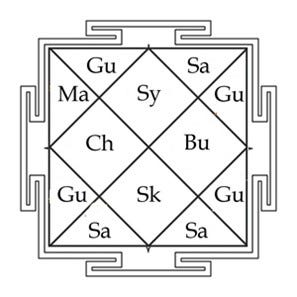
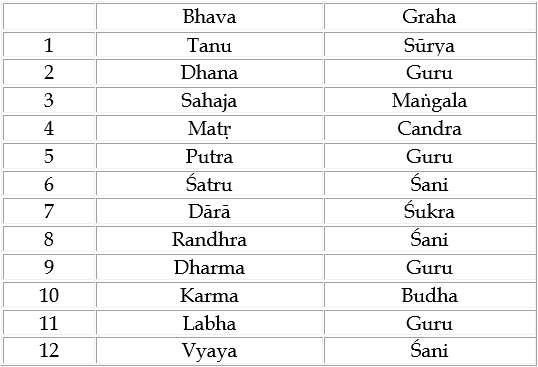
So, the first Bhāva will always depend heavily on how the Kāraka is positioned in relation to it. The Kāraka is someone who has a key role related to the Bhāva. If the Kāraka does not approve something, then that thing cannot happen.
The next thing we will need is the natural rulership of the Grahas.
Here, it essentially refers to Kāla Puruṣa. In Kāla Puruṣa, lordships are distributed among the Nava Grahas, and each bhava will have the qualities of the natural zodiac. When we say the natural zodiac or Kāla Puruṣa, we mean the zodiac starting with Meṣa (Aries) and ending with Mina (Pisces). The rulerships are arranged as follows:
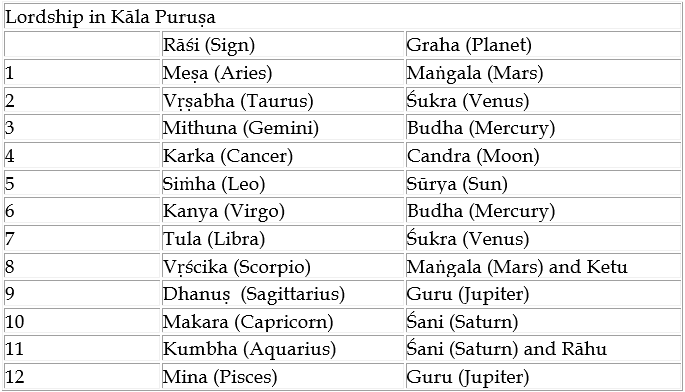
Since we know these things, we should now note the following:
The ruler of a Bhāva will have the internal qualities of the Kāraka and the external qualities of the ruler of the natural Bhāva.
So, the ruler of the first Bhāva will have the internal qualities of Sūrya (Kāraka for the first Bhāva) and the external qualities of Maṅgala (the ruler of the first Bhāva in Kālapuruṣa). That is why a person will be very healthy, because Sūrya in the first bhava feels exalted, while Maṅgala feels as if it is in its own sign (Svarāśi). Maṅgala is the ruler of the natural eighth Bhāva (Vṛścika Rāśi), so it will cause issues related to marriage (the eighth Bhāva is a Māraka for the seventh). When it is said that a person is intelligent, this is shown by Sūrya, which is a Dima Graha. The most important point is that the person will have the internal qualities of Sūrya (intelligence) and the external qualities of Maṅgala (physical strength, problems in marriage, etc.). Of course, here the qualities are related to the body, since the first Bhāva represents the body.
Let us look at another example: the ruler of the Lagna in the fifth Bhāva
lagneśe sutage jantoḥ sutasaukhyaṁ ca madhyamam | prathamāpatyanāśaḥ syānmānī krodhī nṛpapriyaḥ || 5||
5. If the ruler of the Lagna is in the Putra Bhāva, the person will have moderate happiness related to children, will lose their first child, will be dignified, prone to anger, and dear to the king.
Here we see that Maṅgala plays a very large role, because the external characteristics will be connected to the effects of Mangala in the fifth Bhāva. The fifth Bhāva is Chitta, which is constantly on the mind. Therefore, the person will be prone to anger.
Kalyana Varma in Sārāvalī, in Chapter 30, gives the following effects for Sūrya in the fifth Bhāva:
6. If Sūrya is in the fifth Bhāva, the person will be deprived of happiness, children, and wealth, will live by agriculture, will move to hills or a fortress, will have a changeable mind, will be learned, deprived of strength, and short-lived.
The internal characteristics will be connected to Sūrya; thus, the person will have a changeable mind and will be learned.
In this way, all effects of Bhāva rulers in different placements can be interpreted.
For example, if we want to see how the ruler of the second Bhāva will behave, then for internal characteristics we take Guru, which is the Kāraka for the second Bhāva, and for external characteristics we take Śukra, which is the natural ruler of the second Bhāva. For the third, the internal qualities are of Maṅgala, and the external qualities are of Budha, and so on…
Example 1
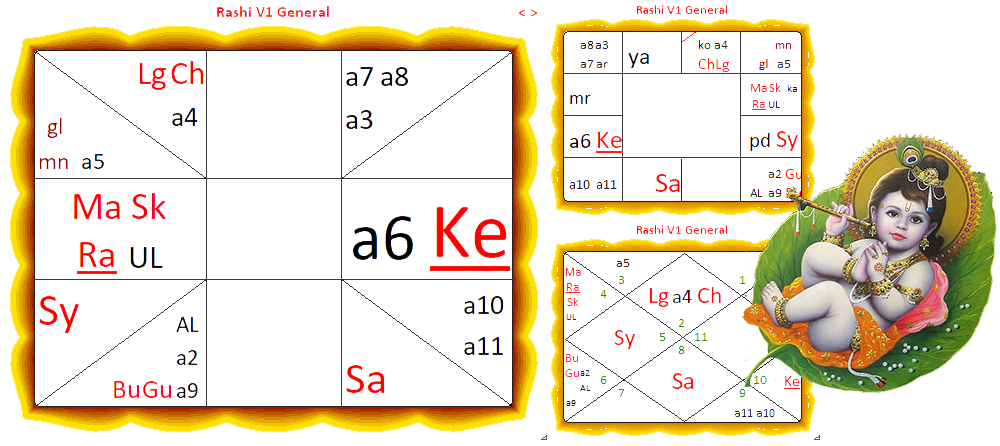
In the chart of Śrī Kṛṣṇa, the ruler of the Lagna is in the third Bhāva, and Parāśara says:
लग्नेशे सहजे जातः सिंहतुल्यपराक्रमी।
सर्वसम्पद्युतो मानी द्विभार्यो मतिमान् सुखी॥ ३॥lagneśe sahaje jātaḥ siṁhatulyaparākramī |
sarvasampadyuto mānī dvibhāryo matimān sukhī || 3||
3. If the ruler of the Lagna is in the Sahaja Bhāva, the person will be equal to a lion in courage, will be endowed with various kinds of wealth, will be dignified, will have two wives, will be intelligent and happy.
Now let us see the effects related to Sūrya in the third bhava, in order to understand the internal characteristics of the ruler of the Lagna.
Sārāvalī says:
If Sūrya is in the third bhava, the person will be courageous, strong, will lose siblings, will be dear to people, good-looking, very learned, and will defeat enemies.
If Maṅgala is in the third bhava, the person will be courageous, unconquerable, separated from (or without) siblings, charming, will possess all virtues, and will be famous.
Learning (he spoke the Bhagavad Gita to Arjuna), courage, and strength are internal characteristics that Śrī Kṛṣṇa undoubtedly possessed. Also, invincibility, even from early years, is something that externally accompanied Śrī Kṛṣṇa, not to mention fame. Separation from siblings did occur, because Kamsa killed each of Kṛṣṇa’s brothers, so he had to be hidden with Yasoda.
Example 2
Parāśara:
लग्नेशे सप्तमे पापे भार्या तस्य न जीवति।
शुभेऽटनो दरिद्रो वा विरक्तो वा नृपोऽपि वा॥ ७॥lagneśe saptame pāpe bhāryā tasya na jīvati |
śubhe’ṭano daridro vā virakto vā nṛpo’pi vā || 7||
7. If the ruler of the Lagna is malefic and placed in the Yuvati (Dārā or seventh) Bhāva, the person’s wife will not live long. If the Graha is benefic, the person will wander aimlessly, face poverty, and be rejected. The person may also become a king if that Graha is strong.
Sārāvalī:
8. If Sūrya is in the seventh Bhāva, the person will be poor, offensive, suffer from bodily diseases, face problems with the king and imprisonment, follow bad paths, and will not be good toward the wife.
9. If Maṅgala is in the seventh Bhāva, the person will lose their wife, suffer from diseases, follow bad paths, be unhappy, separated from wealth, bring misfortune, and be lean.
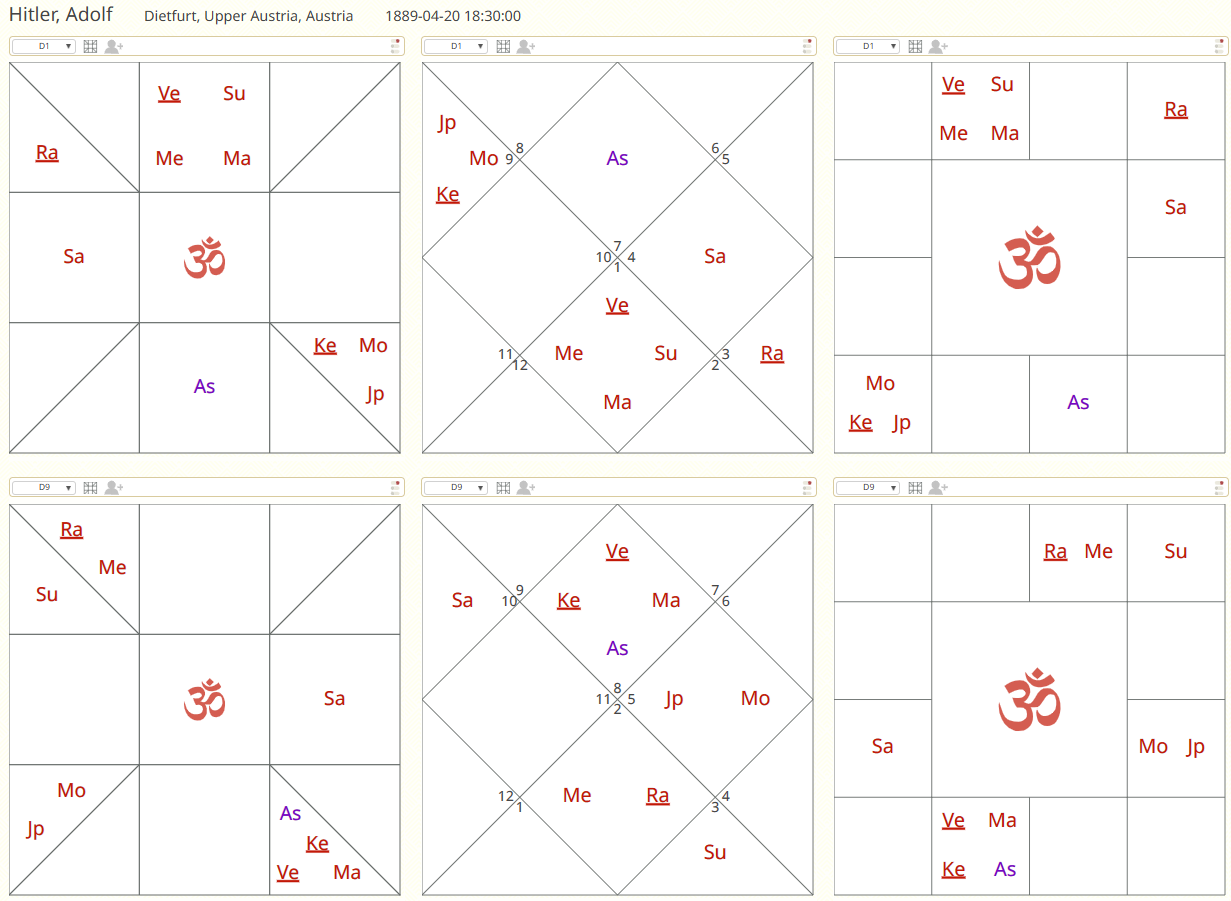
In the chart of the initiator of World War II, Śukra is the ruler of the Lagna, placed in the seventh Bhāva. The internal characteristics of Sūrya in the seventh are seen from Sārāvalī, which strongly describe his nature. The external ones are taken from Maṅgala, and almost every one of these characteristics can be applied to his personality and actions.
Here we see that all the effects given in the classics can be very well assessed, provided we have the correct key.
Effects of the Lord of the First Bhāva in All Bhāvas (BPHS Chapter 24)
Below are the effects of the ruler of the first Bhāva in all Bhāvas, which is part of Chapter 24 of the Bṛhat Parāśara Horā Śāstra:
लग्नेशे लग्नगे देहसुखभाग् भुजविक्रमी।
मनस्वी चञ्चलश्चैव द्विभार्यो परगोऽपि व॥ १॥lagneśe lagnage dehasukhabhāg bhujavikramī |
manasvī cañcalaścaiva dvibhāryo parago’pi va || 1||
1. If the ruler of the Lagna (ascendant) is in the Lagna itself, the person will be endowed with physical happiness and strength. They will be very intelligent, of a changeable mind, will have two wives, and will unite with other women.
लग्नेशे धनगे बालो लाभवान् पण्डितः सुखी।
सुशीलो धर्मविन्मानी बहुदारगुणैर्युतः॥ २॥lagneśe dhanage bālo lābhavān paṇḍitaḥ sukhī | suśīlo dharmavinmānī bahudāraguṇairyutaḥ || 2||
2. If the ruler of the Lagna is in the Dhana Bhāva, the person will have gains, be learned, happy, endowed with good qualities, religious, dignified, and will have many wives.
लग्नेशे सहजे जातः सिंहतुल्यपराक्रमी।
सर्वसम्पद्युतो मानी द्विभार्यो मतिमान् सुखी॥ ३॥lagneśe sahaje jātaḥ siṁhatulyaparākramī |
sarvasampadyuto mānī dvibhāryo matimān sukhī || 3||
3. If the ruler of the Lagna is in the Sahaja Bhāva, the person will be equal to a lion in courage, endowed with various kinds of wealth, dignified, will have two wives, intelligent, and happy.
लग्नेशे सुखगे बालः पितृमातृसुखान्वितः।
बहुभ्रातृयुतः कामी गुणरूपसमन्वितः॥ ४॥lagneśe sukhage bālaḥ pitṛmātṛsukhānvitaḥ |
bahubhrātṛyutaḥ kāmī guṇarūpasamanvitaḥ || 4||
4. If the ruler of the Lagna is in the Bandhu Bhāva, the person will be endowed with happiness from father and mother, will have many siblings, be passionate, virtuous, and charming.
लग्नेशे सुतगे जन्तोः सुतसौख्यं च मध्यमम्।
प्रथमापत्यनाशः स्यान्मानी क्रोधी नृपप्रियः॥ ५॥lagneśe sutage jantoḥ sutasaukhyaṁ ca madhyamam |
prathamāpatyanāśaḥ syānmānī krodhī nṛpapriyaḥ || 5||
5. If the ruler of the Lagna is in the Putra Bhāva, the person will have moderate happiness related to children, will lose their first child, be dignified, prone to anger, and dear to the king.
लग्नेशे षष्ठगे जातो देहसौख्यविवर्जितः।
पापाढ्ये शत्रुतः पीडा सौम्यदृष्टिविवर्जिते॥ ६॥lagneśe ṣaṣṭhage jāto dehasaukhyavivarjitaḥ |
pāpāḍhye śatrutaḥ pīḍā saumyadṛṣṭivivarjite || 6||
6. If the ruler of the Lagna is in the Ari Bhāva and associated with malefics, the person will lack physical happiness and will be troubled by enemies, especially if there is no benefic aspect.
लग्नेशे सप्तमे पापे भार्या तस्य न जीवति।
शुभेऽटनो दरिद्रो वा विरक्तो वा नृपोऽपि वा॥ ७॥lagneśe saptame pāpe bhāryā tasya na jīvati |
śubhe’ṭano daridro vā virakto vā nṛpo’pi vā || 7||
7. If the ruler of the Lagna is malefic and placed in the Yuvati (seventh) Bhāva, the person’s wife will not live long. If benefic, the person will wander, face poverty, be detached, or may become a king if strong.
लग्नेशेऽष्टमगे जातः सिद्धविद्याविशारदः।
रोगी चौरो महाक्रोधी द्यूती च परदारगः॥ ८॥lagneśe’ṣṭamage jātaḥ siddhavidyāviśāradaḥ |
rogī cauro mahākrodhī dyūtī ca paradāragaḥ || 8||
8. If the ruler of the Lagna is in the Randhra Bhāva, the person will be skilled in occult knowledge, but also sickly, a thief, very angry, a gambler, and involved with others’ spouses.
लग्नेशे भाग्यगे जातो भाग्यवाञ्जनवल्लभः।
विष्णुभक्तः पटुर्वाग्मी दारपुत्रधनैर्युतः॥ ९॥lagneśe bhāgyage jāto bhāgyavāñjanavallabhaḥ |
viṣṇubhaktaḥ paṭurvāgmī dāraputradhanairyutaḥ || 9||
9. If the ruler of the Lagna is in the Dharma Bhāva, the person will be fortunate, dear to people, devoted to Vishnu, skilled, eloquent, and endowed with spouse, children, and wealth.
लग्नेशे दशमे जातः पितृसौख्यसमन्वितः।
नृपमान्यो जने ख्यातः स्वार्जितस्वो न संशयः॥ १०॥lagneśe daśame jātaḥ pitṛsaukhyasamanvitaḥ |
nṛpamānyo jane khyātaḥ svārjitasvo na saṁśayaḥ || 10||
10. If the ruler of the Lagna is in the Karma Bhāva, the person will have happiness from parents, royal honors, fame among people, and certainly self-earned wealth.
लग्नेशे लाभगे जातः सदा लाभसमन्वितः।
सुशीलः ख्यातकीर्तिश्च बहुदारगुणैर्युतः॥ ११॥lagneśe lābhage jātaḥ sadā lābhasamanvitaḥ |
suśīlaḥ khyātakīrtiśca bahudāraguṇairyutaḥ || 11||
11. If the ruler of the Lagna is in the Labha Bhāva, the person will always have gains, good qualities, fame, and many wives.
लग्नेशे व्ययभावस्थे देहसौख्यविवर्जितः।
व्यर्थव्ययी महाक्रोधी शुभदृग्योगवर्जिते॥ १२॥lagneśe vyayabhāvasthe dehasaukhyavivarjitaḥ |
vyarthavyayī mahākrodhī śubhadṛgyogavarjite || 12||
12. If the ruler of the Lagna is in the Vyaya Bhāva and without benefic aspects or conjunctions, the person will lack physical happiness, spend wastefully, and have problems with anger.
[1] Dima Grahas are those that give intelligence: Sūrya, Guru, Rāhu, and Ketu.