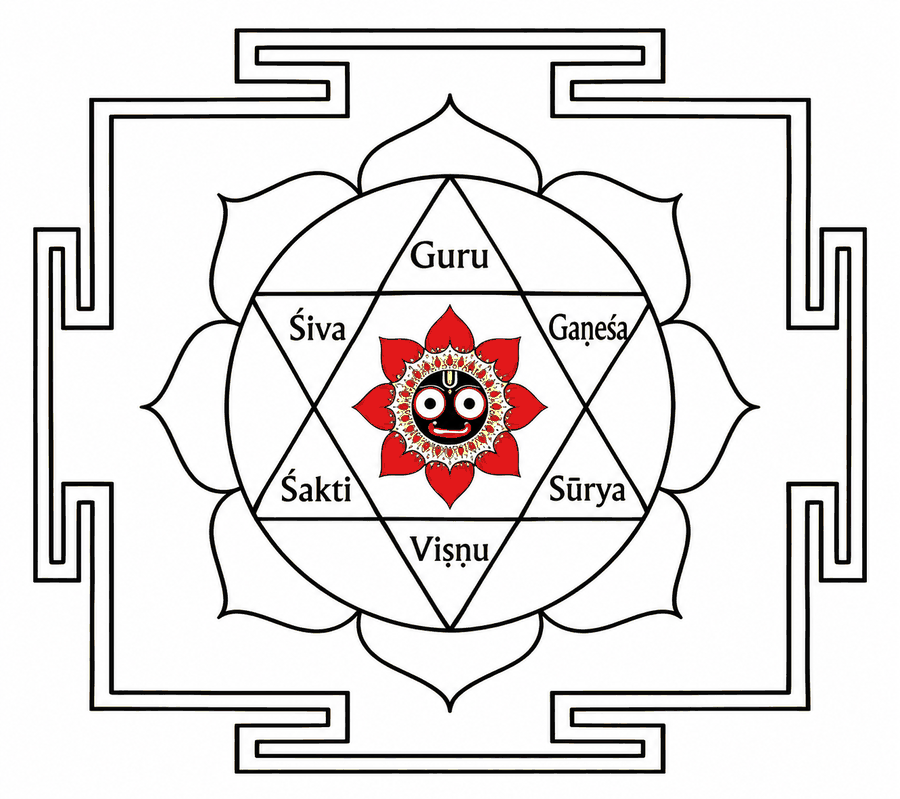
ॐ गणानां त्वा गणपतिं हवामहे कविं कवीनामुपमश्रवस्तमम्।
ज्येष्ठराजं ब्रह्मणां ब्रह्मणस्पत आ नः श्रृण्वन्नूतिभिः सीदसादनम्॥om gaṇānāṁ tvā gaṇapatiṁ havāmahe kaviṁ kavīnāmupamaśravastamam |
jyeṣṭharājaṁ brahmaṇāṁ brahmaṇaspata ā naḥ śrṛṇvannūtibhiḥ sīdasādanam ||
Om Ganeśa, Lord of all seers, praise be to Thee; Thou art Omniscient and the unmatched wisdom of the wise. Thou art the precursor (Om) of all prayer and the Lord of all souls; we pray for Thy guidance for success in all good actions.
“There is no if, there is no but, there is nothing. It’s all simplicity; it’s all naturalness, complete freedom. Anything you can ask and receive the answer. And if there is a doubt on the answer, ask again, ask again. Complete freedom and innocence in this relationship – simplicity, no maneuvering, and no strain. There is no fear. The disciple never feels, Oh, if I say this… All these complications don’t exist. He says what he feels. Fine. It is the most innocent relationship on Earth. And it is most innocent, most spontaneous, most natural, it is most perfect. Nothing is so complete and perfect as that.”
— Mahāṛṣi Mahesh Yogi
Introduction
Root of the word “Bhakti’” coming from the word “Bhaj” which means ‘to be attached to Lord’. Bhajan, worshiping, Anurāga, Prema and Prīti are synonyms for Bhakti. Bhakti is real, truthful search for Lord, which starts, continuing and finishing in Love. Just one moment of extreme love to Lord, can lead us to eternal freedom. “Bhakti,” by Nārada, ‘is intense Love toward Lord. When a man gets it, he loves everybody, hates none; and he is satisfied forever. This love can’t be reduced by any worldly benefits, because as long as worldly desires last, this kind of Love won’t take place in the heart of man. Bhakti is greater than Karma; Bhakti is greater than Yoga, because these are intended for an object in view, while Bhakti is its own fruition, its own means and its own end.”
There is no big difference between knowledge (Jñāna) and Love (Bhakti). In the end, both are seeking for the same destination. But there is lot of misunderstanding in opinions those who teach knowledge (Jñāna) and those who teach Love (Bhakti), although everybody appreciate the power of Bhakti yoga. One great privilege of Bhakti yoga is that it is the most easiest and the most spontaneous way to reach great divine end and big disadvantage is that in its lower forms it oftentimes degenerates into hideous fanaticism. But this danger exists only in that state of Bhakti which is called the preparatory (GAUNI). When Bhakti has become ripe and has passed into that form which is called supreme (PARA), there is no more fear of these hideous manifestations of fanaticism. That soul which is overpowered by this higher form of Bhakti is too near to God of Love to become an instrument for diffusion of hatred.
Kinds of Bhakti
There are different kinds of Bhakti. One of the divisions is on Sakāmya and Niṣkamya Bhakti. Sakāmya Bhakti is devotion because of desires for material gains. Then, the person who wants various material wealth, health, position, do different kinds of Tapas, Japa and offering, to get it. Whatever man want, if his Bhakti is intensive and open hearted and if his prayers come from the heart, he will get everything. But, Sakāmya yoga definitely is not the way to get Mokṣa.
A way to Mokṣa, enlightenment, is Niṣkamya Bhakti, devotion without any prospect, devotion from the pure Love to Lord.
Bhakti Bhāvas
Bhāva or state provides truthful and real connection between devotee and the Lord. When those connections get steady, it grows in the Mahā Bhāva in which devotee lives, moves and do everything for the Lord. This is called Parama Prema, Great Love.
There are five Bhāvas or five states of Bhakti. There are Śānta, Dāsya, Sakhya, Vatsalya and Madhurya Bhāva.
In Śānta Bhāva, the devotee is Śānta or peaceful. He does not jump and dance. He is not highly emotional. His heart is filled with love and joy. Bhīṣma was a Śānta Bhakta.
Śrī Hanuman was a Dāsya Bhakta. He had Dāsya Bhāva, servant attitude. He served Lord Rāma whole-heartedly. He pleased his Master in all possible ways. He found joy and bliss in the service of his Master. In Sakhya Bhāva, God is a friend of the devotee. Arjuna had this Bhāva towards Lord Krishna. The devotee moves with the Lord on equal terms. Arjuna and Krishna used to sit, eat, talk and walk together as intimate friends.
In Vatsalya Bhāva, the devotee looks upon God as his child. Yasoda had this Bhāva with Lord Kṛṣṇa. There is no fear in this Bhāva, because God is your pet child. The devotee serves, feeds, and looks upon God as a mother does in the case of her child.
The last is Madhurya Bhāva or Kanta Bhāva. This is the highest form of Bhakti. The devotee regards the Lord as his Lover. This was the relation between Radha and Kṛṣṇa. This is Ātma Samarpaṇa.
Navavidha – Bhakti
Devotion to the Lord is developed on the nine different ways which is called Navavidha-Bhakti. In the Śrīmad Bhāgavatam and the Viṣṇu Pūraṇa it was told that the nine forms of Bhakti are:
- Śravaṇa (hearing of God’s Lilas and stories),
- Kīrtana (singing of His glories),
- Smaraṇa (remembrance of His name and presence),
- Pādasevana (service of His feet),
- Arcana (worship of God),
- Vandana (prostration to Lord),
- Dāsya (cultivating the Bhāva of a servant with God),
- Sakhya (cultivation of the friend-Bhāva) and
- Ātmanivedana (complete surrender of the self).
Person can achieve Bhakti by following the eleven fundamental factors which Sri Ramanuja had prescribed. They are Abhyāsa or practice of continuous thinking of God; Viveka or discrimination; Vimoka or freedom from everything else and longing for God; Satyam or truthfulness; Ārjavam or straightforwardness; Kriyā or doing good to others; Kalyāṇa or wishing well-being to all; Dāya or compassion; Ahiṁsā or non-injury; Dāna or charity; and Anavasāda or cheerfulness and optimism.
By his own predispositions and feelings native should choose on which way his Bhakti (devotion to Lord) will develop.
Guru Bhakti
Impulse of the truthful spirituality must came from the person whose name is Guru, while the person who accept that impulse is called Śiṣya. In order to transmit that impulse, to any soul, Guru’s soul at the first place must consist power of transmitting to another one; and at the second place, soul that received impulse must be commodious for that. Seed must be the live seed and field must be furrowed, and when this conditions are fulfill, it will bring the great arise of the honest faith.
Guru Bhakti is devotion to teacher. Relation of the allegiance, love and loyalty of the student on any field of learning. On the spiritual level, devotee insists to see his Guru as a highest level of the self. By accommodating to the Guru’s internal nature and wisdom, student slowly transform his own nature, in order to get same peace and illumination which Guru possessed. Guru Bhakti is also manifested through the serving to Guru, meditation on his form, work familiar to the Guru’s mind and to obeying His instructions.
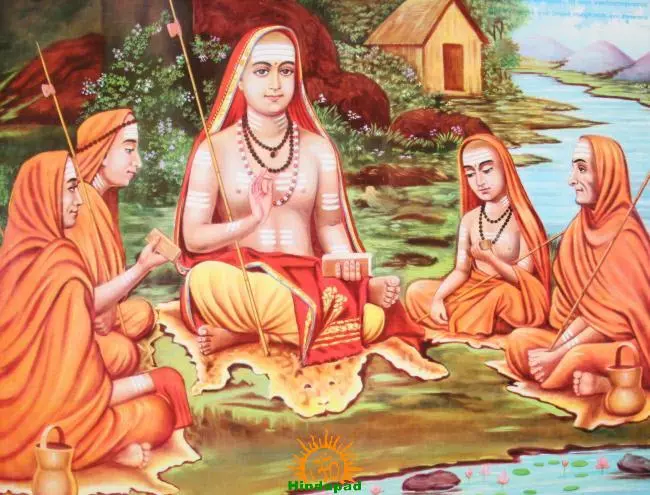
Term, Guru means ‘one who gives light to exterminate darkness of ignorance’. According to ancient Hindu script Advayatāraka Upaniṣad, Guru means ‘dispeller (GU) of darkness (RU). Guru concept is essence ancient Indian concept, which has no any parallel in tradition of other nations. In the ordinary way of speech, term Guru means teacher. To learn anything in the life, relative or spiritual, native needs help of the teacher. Guru’s can be different, depending of attainment in knowledge and of the level at which they impart guidance. Therefore, native should be diligent in locating and identifying a real Guru.
This confirms Guru Gīta where Śiva says to His wife Pārvatī: Verse 9: “Guru is not different from the consciousness. This is an absolute truth. Because of this, wise man must search for his own Guru.”
Verse 23 & 24: “First syllable ‘GU’ mean light, second ‘RU’ darkness. Guru is, without any doubt, Brahma who dispels all darkness.” “Second syllable ‘RU’ is implied in attribute like Maya, and first ‘GU’ is the highest knowledge, which destroy the Maya. (‘GU’ represents highest unmanifested Absolute, while ‘RU’ represent lower manifested world.)’
How big the greatness of the Guru is shown the verse 32:
गुरूर्ब्रह्म गुरूर्विष्णु गुरूर्देव महेश्वरः।
गुरुर्एव परम्ब्रह्म तस्मै श्री गुरवे नमः॥२॥gurūrbrahma gurūrviṣṇu gurūrdeva maheśvaraḥ|
gurureva parambrahma tasmai śrī gurave namaḥ||2||
For better understanding concept of the Guru Bhakti, we must enter deeper in basic principle of Hinduism. Brahma is, based on three types of Guṇa: Sattva, Rajas and Tamas, create whole Universe, beings both animate and inanimate, which were classified as Deva, Manuṣya and Rākṣasa. In one moment all three types of Creation (based on Navāṁśas) are approach to Brahma to ask Him about spiritual advice.
When Devas approach to Brahma for spiritual advice on which way to free them from the bondage of karma, Brahma answered “daṁ”. Devas understand this like “dama” which means they should developed self control as “dama” means taming or subduing the body and mind. This is the highest definition of the guru and represents the Dikṣa guru who is responsible for helping and directing the Śiṣya (spiritual aspirant) in the path of self-realization. Thus, Dikṣa Guru must be the one who control five senses (Jñāna Indiriya) and five organs of action (Karma Indiriya) and the one who has the knowledge of the four Vedas (Caturveda). Only then he will have the power to take off one-sixth of our sins and to put us firmly on the path of self-realization. As Indra became the chief of the gods, Bṛhaspati became their preceptor and the definition of the Dikṣa Guru was based on the attributes of Bṛhaspati. Krishna explains this aspect of perfection in declaring that “among the preceptors I am Bṛhaspati”.
Rākṣasa approach to Creator and demanded their share of knowledge to which Brahma replied ‘dam’. The Rākṣasa understood this to mean ‘daya” or compassion for in their Tamas Guṇa they are forever jealous of the Devas, desiring the bounties of the manifested creation all for themselves and hankering for power. Rākṣasa are not demons and instead it is the manifestation of one of the modes of nature namely Tamas Guṇa, where the created being has certain mental attributes causing jealousy, frustration and a hankering for others wealth and women.
The Manuṣya approached Brahma for spiritual direction and Brahma replied “dam”. The Manuṣya understood that Brahma meant Dāna or to give. Man by nature is selfish and greedy coveting all wealth and tending to store it without sharing. The spiritual message for him was to learn to give and this is the importance of the Upapada. Through the Chandra Upapada he gives to the family and his society that satisfies the Pitṛs. The Sūrya Upapada is what he gives to the Guru and deities and for spiritual growth and emancipation. Thus, giving is the essence of all Manuṣya.
Guru Bhakti and Jyotiṣa
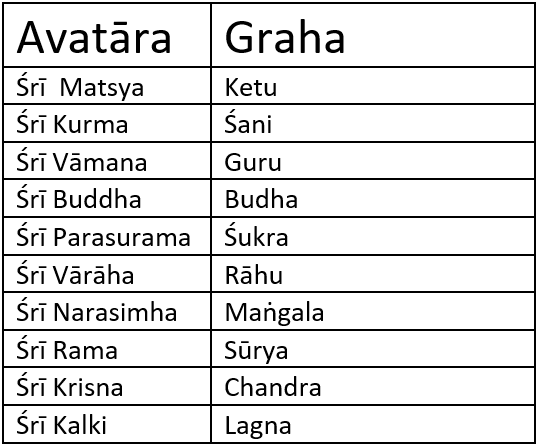
Bhakti and Jñāna is seen from the fifth Bhāva in Rāśi, ninth Bhāva in Navāṁśa chart and from the Vimśāṁśa (Varga 20). The nature of worshiping is seen from the strongest Graha in fifth Bhāva. In regard to Grahas, the Vedic Deities are:
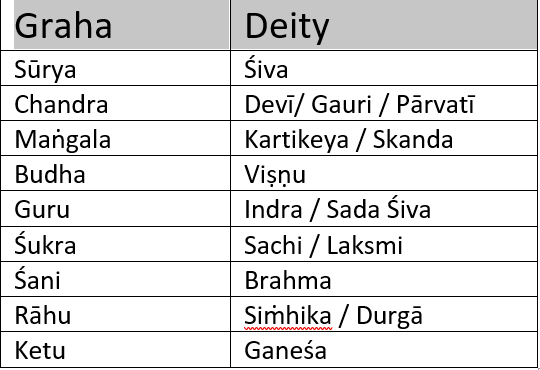
There is a huge scheme of a Bramin’s Deities i other shapes of worshiping in Mediaeval India explained in Jyotiṣa classic ‘Praśna Marga’. Pārāśara and Jaimini confirm this scheme of Vedic deities. Mahāṛṣi Brighu teaches several principles how to choose mantra:
- Grahas in fifth Bhāva- if there is more than one Graha in fifth Bhāva, then the strongest show leading mantra. For example, with Sūrya in fifth, Brighu Sūtram advice worshiping God Sūrya.
- Graha which aspect fifth Bhāva should be chosen only in case if there is no Grahas in fifth Bhāva.
- We should take the mantra from the ruler of the fifth Bhāva only if there is no Grahas in fifth and there is no Grahas which aspect fifth Bhāva. In that case ruler of the fifth Bhāva must have good relationship with Lagneśa.
- If in case given above, ruler of the fifth Bhāva has no good connection with Lagneśa, we should take his dispositor. Similary, durinig the Daśā of Graha, which has no any interaction with the ruler of the fifth or Mantrapada (A5), giving the mantra won’t help to native. We should look Vimśāṁśa (Varga 20) for determinate Graha for mantra.
भाग्यप्रभावगुरुधर्मतप्ः शुभानि सचिन्तयेन्नव मदेवपुरोहिताभ्याम्।
bhāgyaprabhāvagurudharmatapḥ śubhāni sacintayennava madevapurohitābhyām |
Luck/fortune, might/inherit strength/supernatural powers, teachers, dharma, penance, all round good, should all be considered from the 9th house and the priest of the gods (Jupiter and Bhratṛkāraka).
Jātaka Pārijāta – Saptāṣṭamanavamabhāvādhyāyaḥ – śloka 65
In Jaimini’s Upadeśa Sūtra, Jyotiṣa classic we saw that the ninth Bhāva from Navāṁśa Lagna and ninth Bhāva from the Kārakāmśa are very important for developing religiosity of the native.
समे शुभद्दग्योगात् धर्मनित्यः सत्यवादी गुरूभश्च॥
same śubhaddagyogāt dharmanityaḥ satyavādī gurūbhaśca ||
Benefics in the ninth from Svāṁśa make one righteous, honest (& truthful) and faithful/devoted to teachers and elders.
अन्यथा पपैः॥
anyathā papaiḥ ||
Malefics associated with the ninth produce the opposite qualities like dishonesty, faithlessness and unrighteousness.
The Naisargika Kāraka for Guru is Jupiter, while the Chara Kāraka for the same is the Bhratṛkāraka. The Navāṁśa sign of the Bhratṛkāraka itself is seen for the Guru Devatā or Guide & teacher of the chart. The Guru(s) are indicated by the Bhratṛkāraka as well as the planets conjoining and aspecting it in the Navāṁśa. These Guru(s) would be teaching Dharma, Jyotiṣa etc. i.e. Veda or Vedāñga.
Jaimini Upadeśa Sūtra explains the importance of Bhratṛkāraka in chart:
अमात्यानुचराद् देवता भक्तिः॥
amātyānucarād devatā bhaktiḥ ||
The deity the native will adore is seen from the Bhratṛkāraka.
There are many traditional tools for timing the event of meeting the Guru or spiritual guide. These include:
- The aspect of transit Jupiter (by Rāśi Dṛṣṭi or sign sight) on the Mantrapada (A5) brings one into contact with the Guru and the receipt of Guru Mantra can take place if other factors favour.
- The transit of Ketu in trines to the Āruḍha Lagna (AL) makes a person spiritually inclined and renunciation can occur.
- The Dṛg Daśā of the Āruḍha Lagna surely gives spirituality and can make a person join a spiritual/ religious order.
- The Vimsottari Daśā of planets influencing the fifth and ninth houses gives the knowledge of Mantra and Guru. This is also to be seen in the Vimśāṁśa (D-20) Chart.
Religiosity and spiritual learning is seen from the Vimśāṁśa chart (Varga 20). Grahas in trine shows which Devatā will native worship and also their mantras. Mantra is seen from the ninth Bhāva (Japa), Bhakti (Love, worshiping any shape of Lord) is seen from the fifth Bhāva, while meditation is seen from the twelfth Bhāva. Karaka for the 9th Bhāva is Guru, for 5th is Śukra and 12th is Ketu. Pārāśara explained which Devatā native should worship considering Vimśāṁśa:
काली गौरी लक्ष्मीविजया विमला सती।
तारा ज्वालामुखी श्वेता ललिता बगलामुखी॥ १८॥kālī gaurī lakṣmīvijayā vimalā satī |
tārā jvālāmukhī śvetā lalitā bagalāmukhī || 18||प्रत्यङ्गिरा शची रौद्री भवानी वरदा जया।
त्रिपुरा सुमुखी चेति विषमे परिचिन्तयेत्॥ १९॥pratyaṅgirā śacī raudrī bhavānī varadā jayā |
tripurā sumukhī ceti viṣame paricintayet || 19||
Kālī, Gaurī, Jaya, Lakṣmi, Vijayā, Vimalā, Satī, Tārā, Jvālamukhī, Śvetā, Lalitā, Bagalāmukhī, Pratyañgirā, Śacī, Raudrī, Bhavānī, Varadā, Jayā, Tripurā, Sumukhī are the names of the odd signs Vimśāṁśa.
समराशौ दया मेधा छिन्नशीर्षा पिशाचिनी।
धूमावती च मातङ्गी बाला भद्रऽरुणानला॥ २०॥samarāśau dayā medhā chinnaśīrṣā piśācinī |
dhūmāvatī ca mātaṅgī bālā bhadra’ruṇānalā || 20||पिङ्गला छुच्छुका घोरा वाराही वैष्णवी सिता।
भुवनेशी भैरवी च मङ्गला ह्यपराजिता॥ २१॥piṅgalā chucchukā ghorā vārāhī vaiṣṇavī sitā |
bhuvaneśī bhairavī ca maṅgalā hyaparājitā || 21||
In even signs the names are: Dayā, Medhā, Cinnaśirṣā, Piśaucinī, Dhūmāvatī, Mātañgī, Bālā, Bhadra, Āruṇa, Analā, Piñgalā, Cuccukā, Ghorā, Vārāhī, Vaiṣṇavī, Sitā, Bhuvaneśī, Bhairavī, Mañgalā and Aparājitā.
Case 1: Traditional method for determinate meeting with the Guru
Female born 23th September 1982 in Sarajevo.
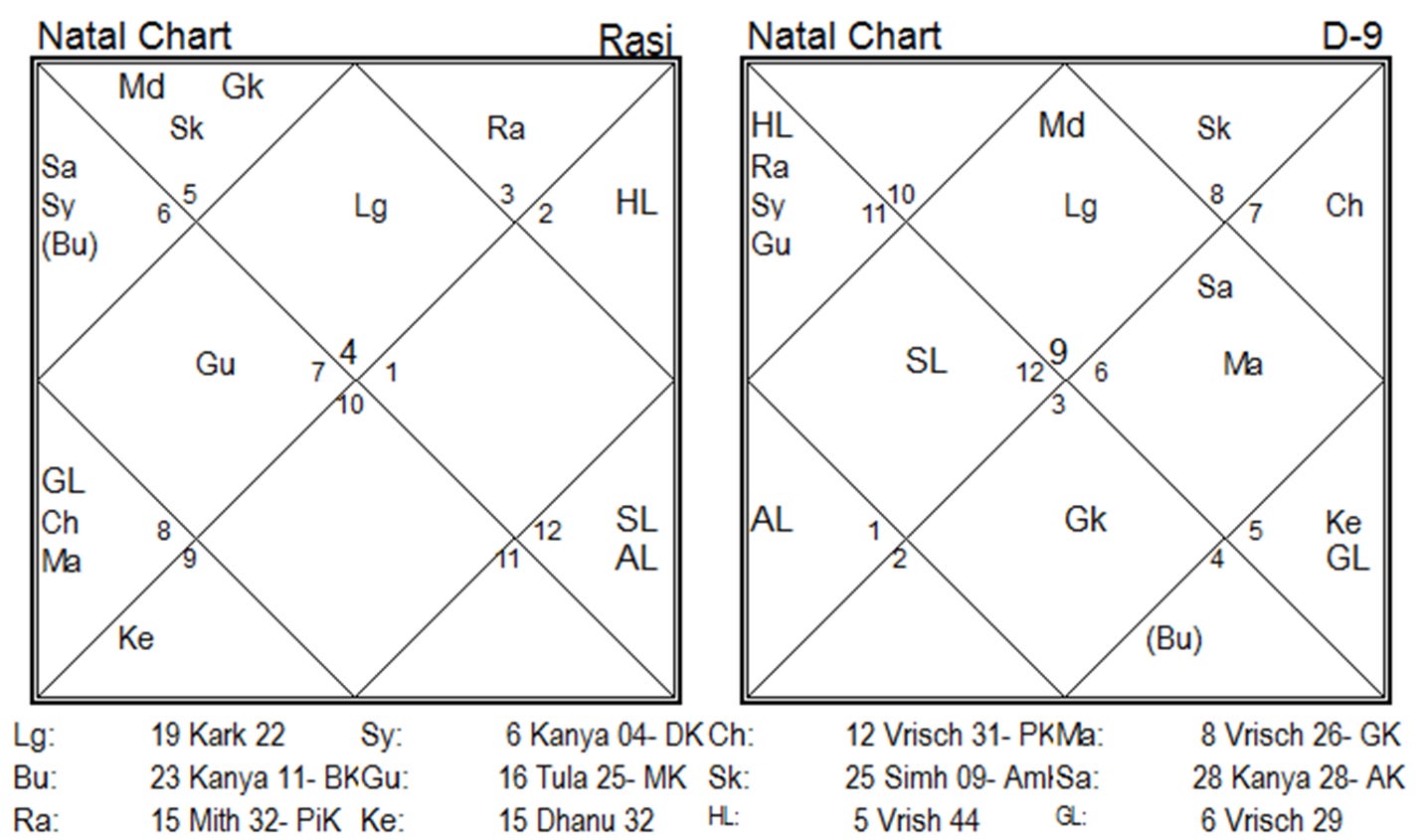
In the first place, we must determinate Iṣṭādevatā, Pālana Karta, Dharma Devatā and Guru Devatā.
Iṣṭādevatā
Iṣṭādevatā is leading Deity; it is Devatā whose purpose is to bring our Ātma to Lord. Iṣṭādevatā is relation between Jīva (individual soul) and Pāramātma. For determination Iṣṭādevatā the most important is position of Ātmakāraka in Navāṁśa chart. Graha in the 12th Bhāva from it, or if there is no Graha, then the ruler of that Bhāva becomes Iṣṭādevatā. Iṣṭādevatā cannot be the same Graha as Ātmakāraka, except in the cases of Divine Incarnations.
In case 1, 12th Bhāva from Ātmakāraka in Navāṁśa is Siṁha. Iṣṭādevatā is Ketu, placed in Siṁha. Ketu shows Śrī Ganeśa. Since, Siṁha is fiery sign, Agni Tattva, direction of Iṣṭādevatā is east.
Pālana Kārta
Pālana Karta is Devatā which rules over relative, material value. Pālana Kārta is determinate by position Amātyakāraka in Navāṁśa chart because Graha in the 6th Bhāva from it shows our Pālana Kārta. If there is two or more Grahas, we take the strongest one, unless there is no Graha in that Bhāva, we look the rulership. In case 1 Amātyakāraka is Śukra in Vṛścika and 6th from it is Meṣa, where is also Āruḍha Lagna. Because we don’t have any Grahas in the Meṣa, Chandra from Tula, Śukra from Vṛścika, Rāhu, Surya and Guru from Kuṁbha by aspecting on it create situation that the native can worship all this Devatās, although Rāhu is the strongest in Kuṁbha Rāśi, which represent Śrī Durgā.
Dharma Devatā
Dharma Devatā is the Deity who’s taking care about our Dharma, about leading principles of Ātma. Dharma Devatā is defined by the strongest Graha in the 9th Bhāva from Kārakāmśa or by the ruler of the 9th Bhāva in case if there is no Graha in it. Dharma Devatā should worship if we want to harmonize our individual Dharma with Universal One.
In case 1, 9th Bhāva from the Kārakāmśa is Vṛṣabha and there is no Graha in it, we will take lordship. Śukra rules over Vṛṣabha and becomes Dharma Devatā, placed in 3rd Bhāva from Kārakāmśa and in 12th from Navāṁśa Lagna.
Guru Devatā
After we determinate Devatā for spiritual life, Devatā for material, relative level, we need to discover Guru – spiritual teacher. Bhratṛkāraka and its position in Navāṁśa will show us who can be our Guru. Bhratṛkāraka in Carakāraka Scheme shows brothers, sisters, somebody that we share energy with, spiritual brother who will lead us to the Father.
Guru Devatā is Budha, placed in 8th Bhāva from Navāṁśa Lagna.
The beginning of the spiritual way
Native entered to ISKON in 19th of May 2002.
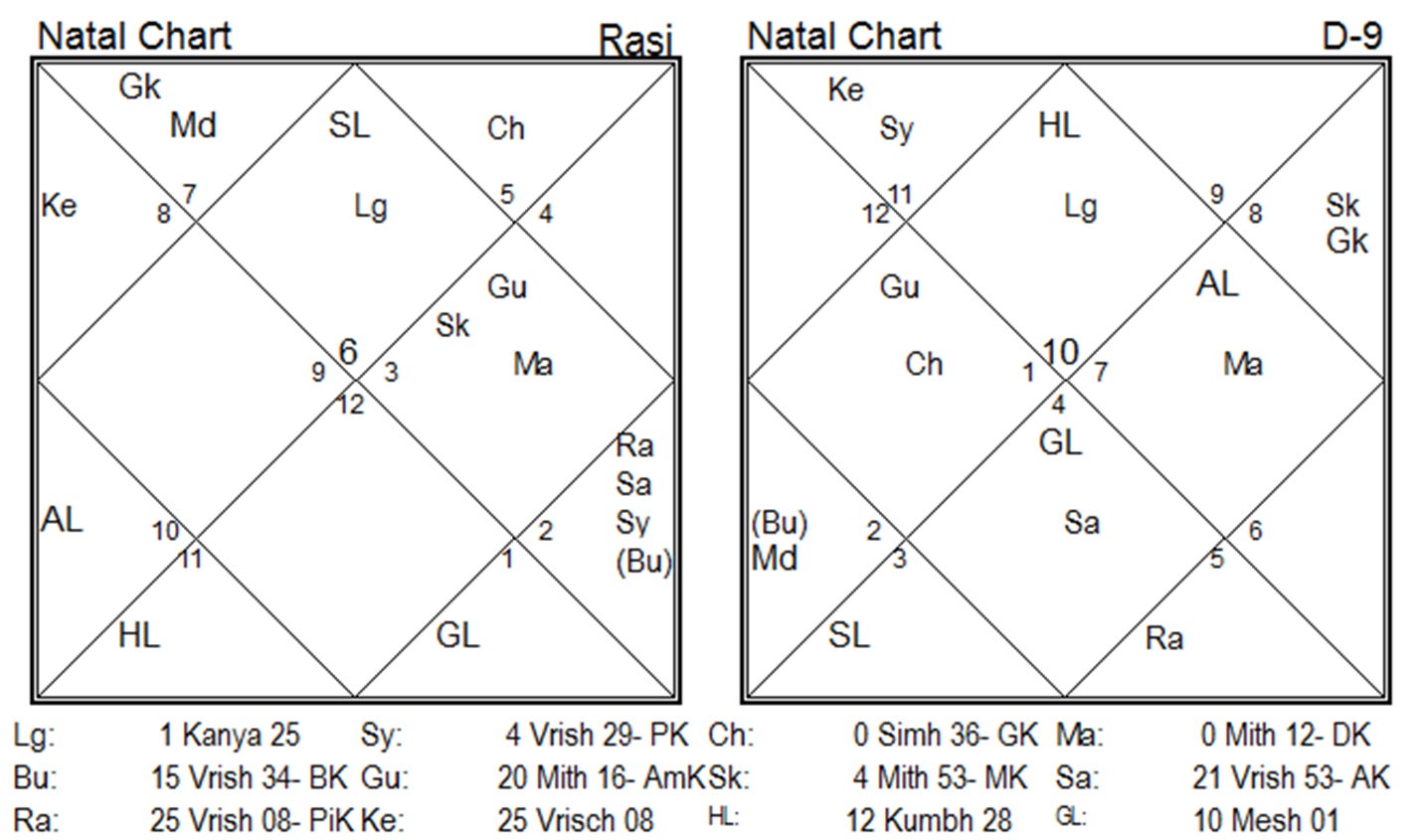
From the transit chart we saw that Ātmakāraka (Śani), Bhratṛkāraka (Budha) and Pālana Kārta (Rāhu) were transiting Dharmapāda (Āruḍha of the 9th Bhāva). Iṣṭādevatā (Ketu) was placed in trines from Āruḍha Lagna and Lagna, which is resulted in tendency for spiritual way of life. In Vimsottari Daśā, it was the Mahā Daśā of Guru Devatā (Budha), Antar Daśā of Guru and Pratyantara Daśā of the Lagneśa.
Initiation
She got the initiation from her Guru in the 1st September 2004 in Sarajevo, Bosnia and Herzegovina.
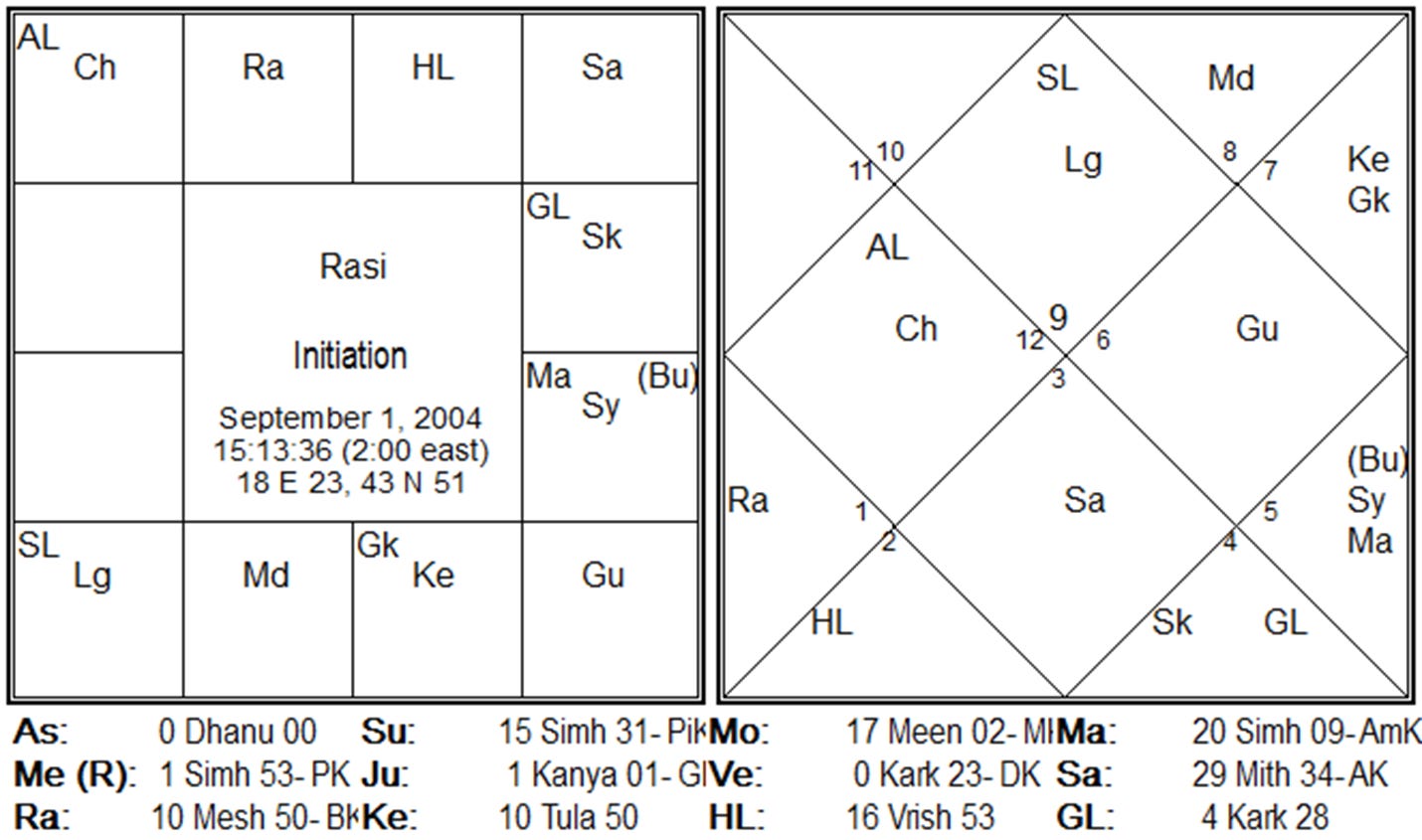
Here we saw that Guru has his fifth Dṛṣṭi on Mantrapada (Āruḍha of 5th Bhāva). Initiation was in Budha (Guru Devatā) Mahā Daśā, Śani (Ātmakāraka) Antaradaśā and Chandra (Lagneśa and Dispositor of Ātmakāraka in Navāṁśa).
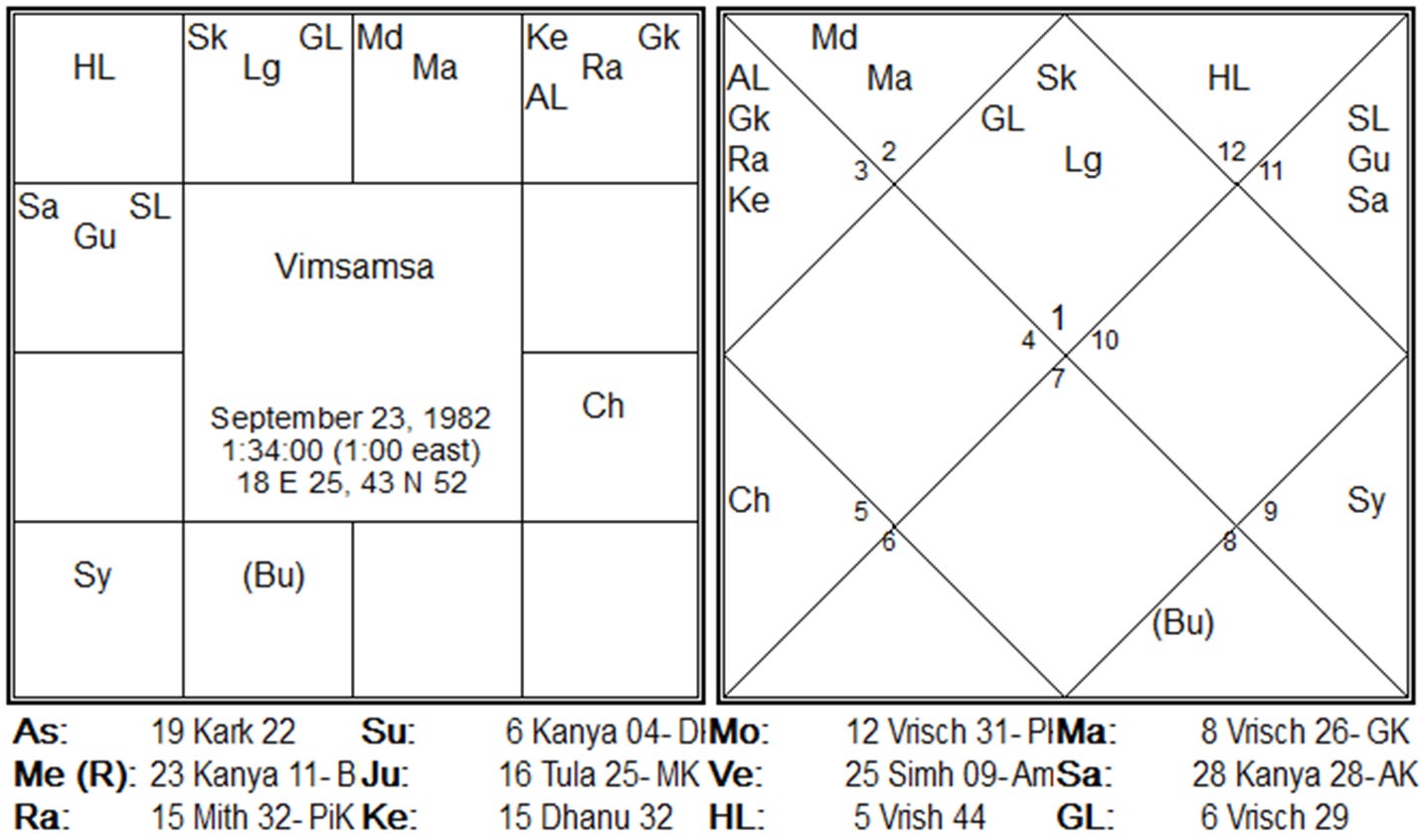
Who is the leading Deity we saw from Vimśāṁśa where the Surya, Chandra and Śukra are in trine. Śukra in Lagna shows the Bhakti yoga, Surya in 9th Bhāva shows righteous relation and great respect toward Guru and Chandra in 5th Bhāva shows that what we pray for and in this case is Lord Śrī Kṛṣṇa, which is the Devatā of Chandra.
Guru Bhakti
From the 5th Bhāva in Rāśi chart and 9th Bhāva in Navāṁśa chart, is seen Guru Bhakti (devotion to Guru). From Navāṁśa Lagna we see which kind of Bhakti we have. From 9th Bhāva from Kārakāmśa we saw the Dikṣa Guru and Dharma Devatā. Dikṣa Guru is also seen from the position of Bhratṛkāraka in Navāṁśa. Does the native have or haven’t got Dikṣa Guru, it’s depend on Dharma.
Ninth Bhāva in Navāṁśa signified relation with a Guru. Grahas like Guru and Surya shows highest respect toward Guru, while their connection will lead to some very good deeds, like building a temple, complete loyalty toward Guru, etc. Most badly position there is of Chandra, because it shows relationship with Guru or with his wife. Best situation is if there is no Grahas at all, other than Guru and Ketu.
Text 1.2.51 — रविगुरूभ्यां गुरविश्वासः॥ — ravigurūbhyāṁ guraviśvāsaḥ ||
If Sun and Jupiter are in the 9th house, the native is a confidant (or faithful) of his elders and teachers.
Text 1.2.50 — शनिरहुभ्यां गुरूद्रोहः — śanirahubhyāṁ gurūdrohaḥ
If Saturn and Rahu are in the 9th house, the native betrays his elders and preceptors.
Text 1.2.52 — तत्र भृद्वङ्गारक वर्गे पारदारिकः॥ — tatra bhṛdvaṅgāraka varge pāradārikaḥ ||
Venus or Mars owning the second house from Svāṁśa produces passion and illicit relationships.
If we worship Lord Vishnu in the shape of Graha in the 9th Bhāva then it will be good relation. Pārāśara gives the list of Avatars for each Graha:
Case 2: Obstacles for getting Dikṣa Mantra
Male born 9th October 1976 in 22:06:13 (4:00 west)
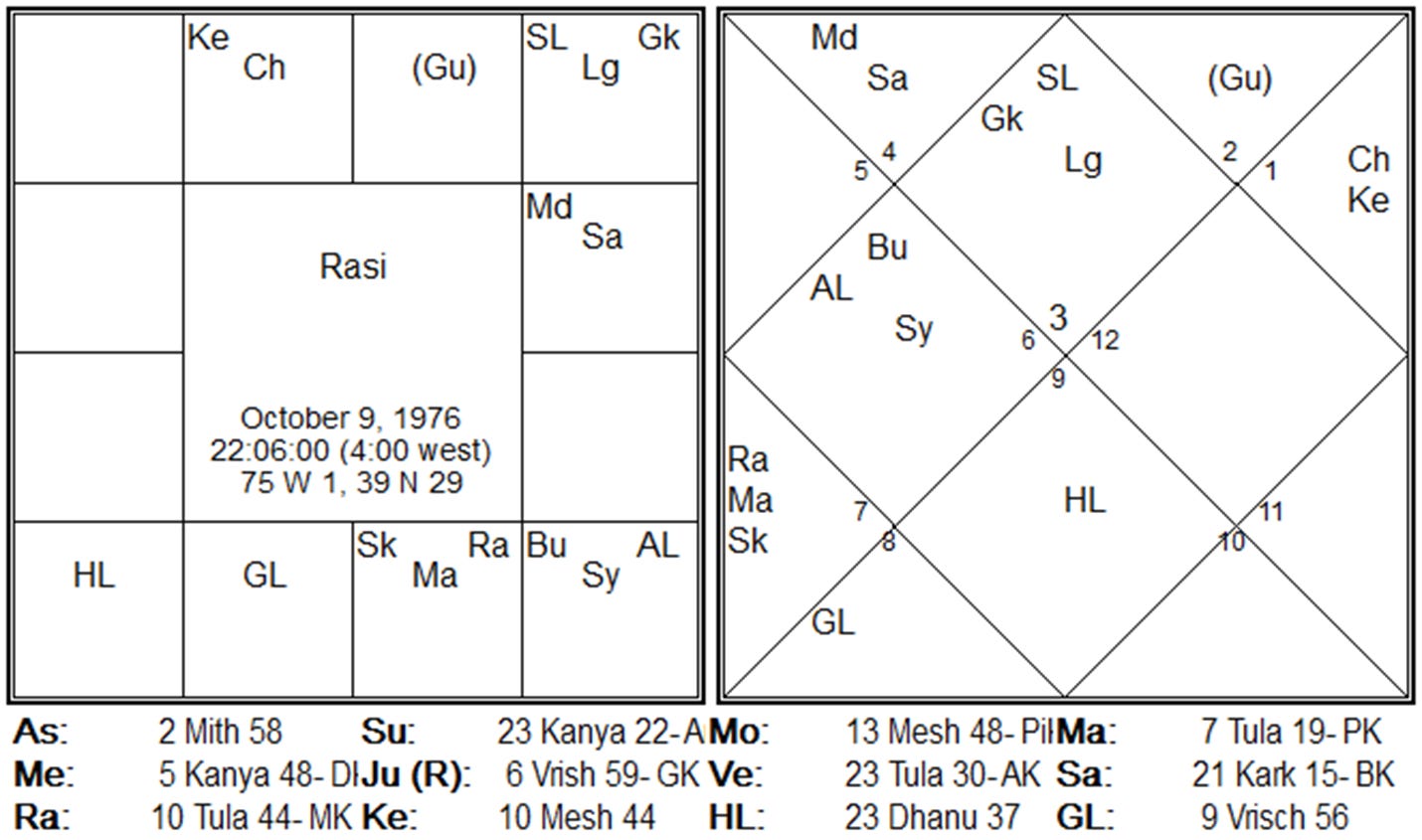
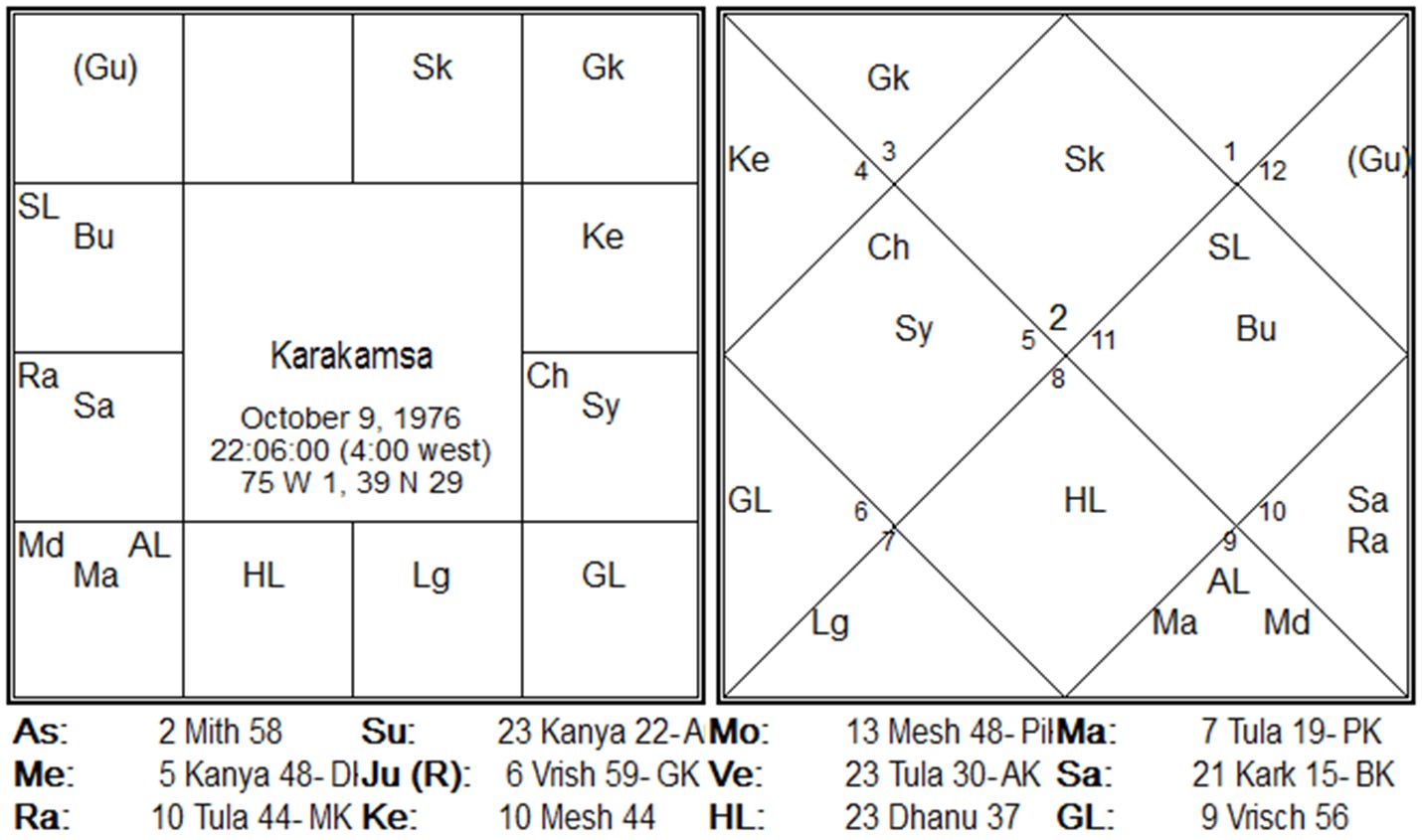
During the Surya – Shukra Dasa native was came to India to find his Diksha Guru, but he meets and stays with her next two week. In a meantime his Diksha Guru dies. In 9th bhava from Karakamsha is yuti Shani-Rahu, which is Shrada Yoga – deadly combination. Rahu is in Marana Karaka Sthan for Karakamsha Lagna and Shani and Rahu had rasi Dṛṣṭi of Shukra. Rahu also represent strangers, that girl was a stranger, came from Australia. And everything is happening in Antar Dasa of Shukra (Atma karaka), for who Sacred Scripts say that native must holdback from illegal relations and desires. Shukra rules over Karakamsha and also the Navamsha Lagna. Shrada yoga is in 8th bhava from the 9th bhava from Navamsha Lagna, which shows the weakness of the 9th bhava. 9th bhava from Navamsha Lagna shows physical relation with Guru, which means that Shrada yoga is very sensitive point in a relation with Guru.
In order to have Diksha Mantra again, he needed to came to Puri and wait for Guru’s Antar Dasa. When he was in Delhi, on his way to Puri, he got news about serious illness of the father and he had to go back in America. Shrada yoga in 4th bhava in Navamsha is the 8th bhava from the 9th, fathers weakness and sickness.
Bhatrukaraka in 9th bhava from Karakamsha show that native honestly want Diksha Mantra but whenever he go for it, Shrada yoga is activated. Remedy measures in this case is, first we look who is stronger, Shani or Rahu and because the Shani is in own sign, native should worship for a year Shani with mantra Kurma avatar: Om Namo Bhagavate Akuparaya.
Case 3: Obstacles because of Pasaca Yoga
Male born 7 August 1963 in 21:15:40 (5.30 EAST)
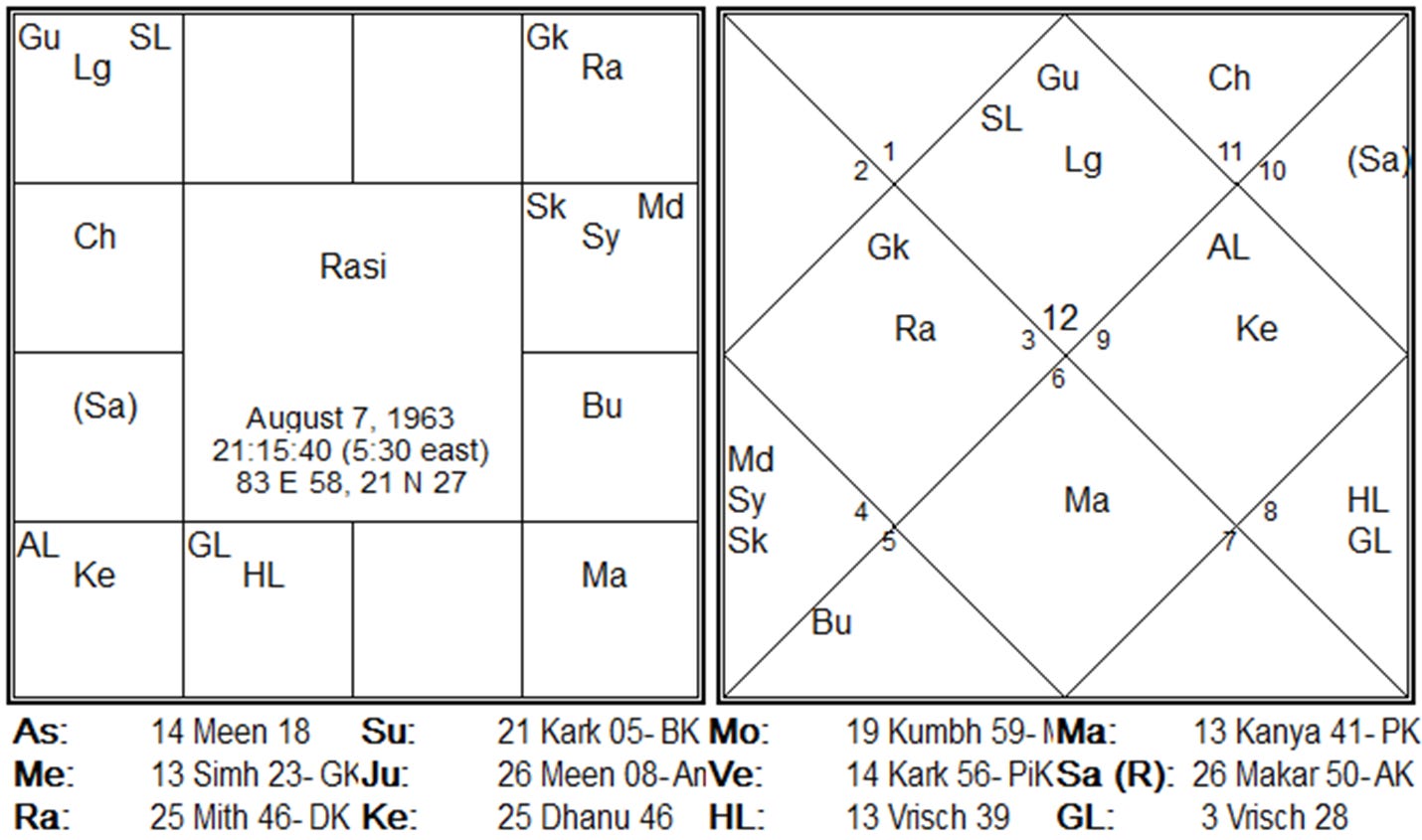
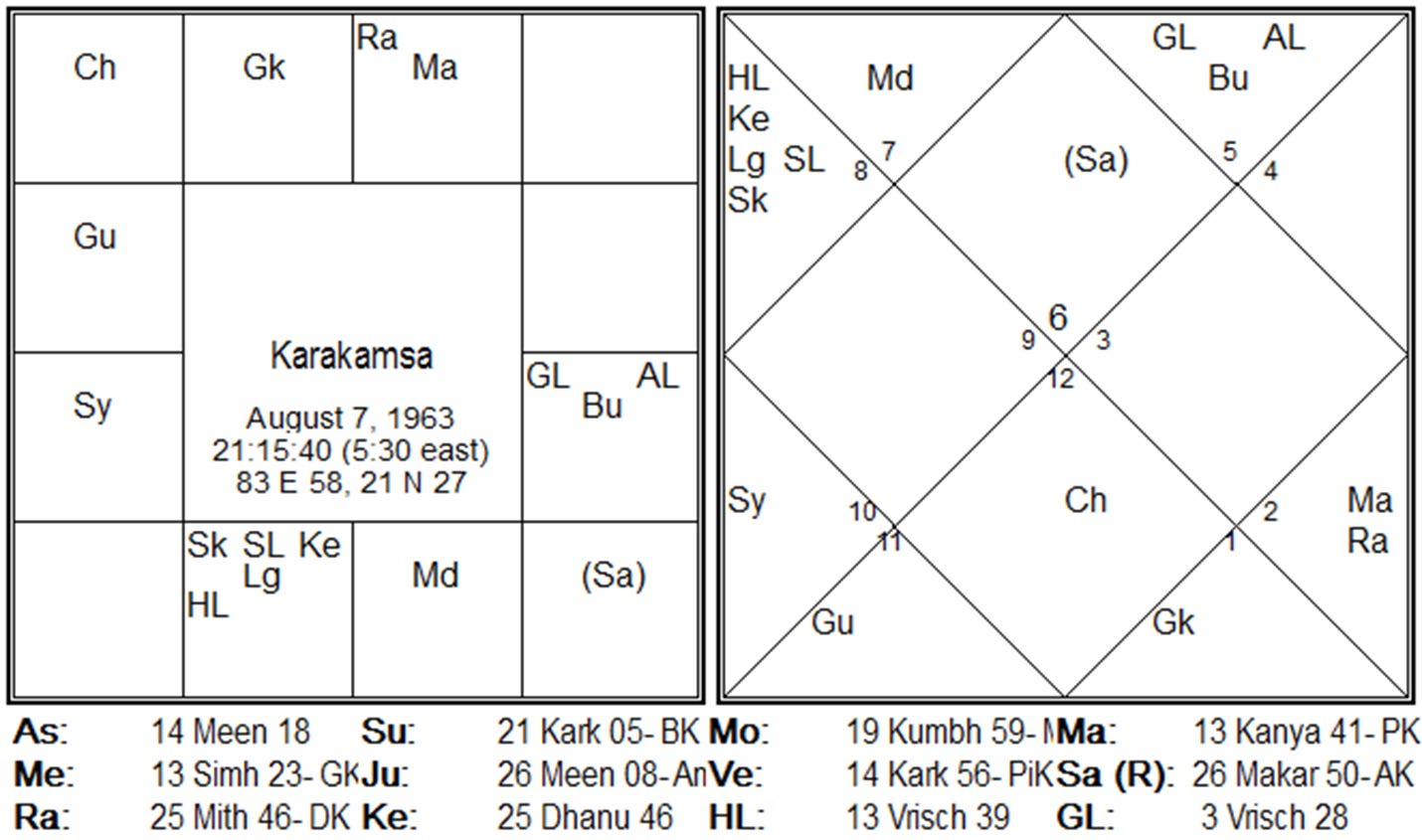
In this case, in the 9th bhava from Kārakāṁśa there is Pasaca yoga (Mangala-Rahu yuti). Native’s Guru told to him that he mustn’t drive in those days, but the native drive motorcycle and had crash. Mangala is in Parivathana yoga with Shukra (represent the vehicle) and Shukra is very afflicted. Surya, Bhatrukaraka has very good position in the 5th bhava from Karakamsha Lagna which also shows that the native truly want Diksha Mantra.
Native got Gayatri Mantra (Surya) in Puri, because of the strenght and aspect of Surya (Guru Devata) on 9th bhava from Kārakāṁśa by rashi Dṛṣṭi and on 9th bhava from Navamsha Lagna by graha Dṛṣṭi and also because of Surya’s placement in the fifth bhava.
When it is in the 9th bhava Shrada or Pasaca Yoga, native can have Diksha Mantra only in the place of Pilgrimage.
Great role for getting Dikṣa Mantra, plays Bhrātṛkāraka, apropos Guru Devata in chart. If Bhrātṛkāraka aspecting Karakamsha Lagna, native want to get Diksha Mantr and if aspecting 9th bhava from Karakamsha, native will get Diksha Mantra even if don’t want it. Only in the cases when Bhrātṛkāraka aspecting 9th hava from Karakamsha Lagna, Guru want to give us a Mantra by himself, otherwise, we must ask for it. Bhrātṛkāraka show also what kind of knowledge Guru want to give to Shishya. By connecting karakatvas of the Grahas we can see what our Guru is doing for us. If Bhrātṛkāraka is Surya, then we will get Supreme knowledge from our Guru, if it is Chandra – Guru will teach us about feelings and emotions, if Bhrātṛkāraka is Mangal – indicates Ahimsa principles, if it is Budha – most important lesson will be the Satya, when it is Guru – it will show highest dharmic principles, for Shukra it relation with the others, Guru wili remove the suffering from the Shishya if Bhatru Karka is Shani. If it is Rahu – Guru will remove all the sins and if it is Ketu – Guru will lead you straight to Moksha.
Also Rashi where is Bhrātṛkāraka Navamsha chart or it’s trine or the 7th bhava from it, if it stronger can show the Lagna of the Guru. We can see this in the next example:
Case 4
Male born 1 February 1969 in 5:27:03 (1:00 East)
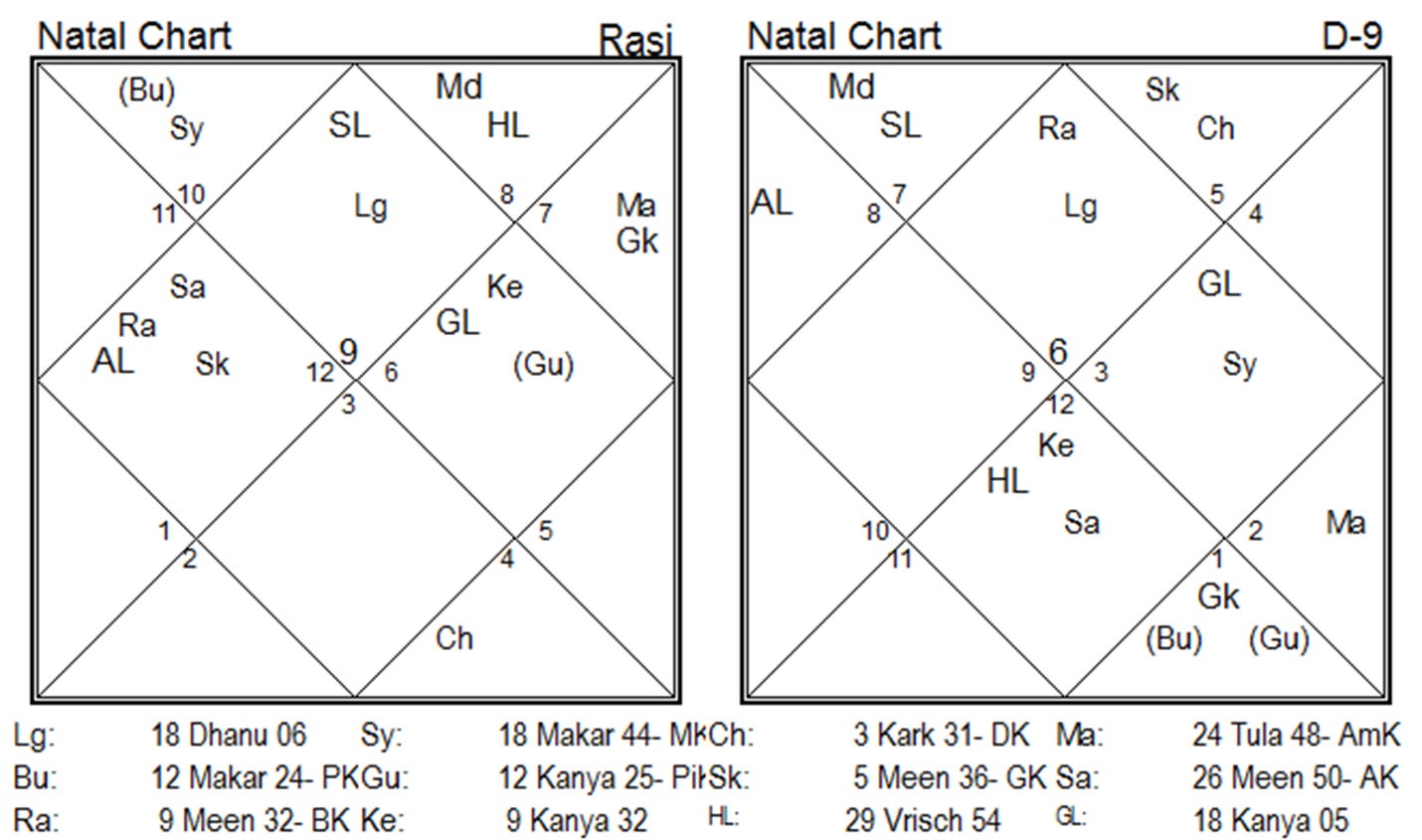
Here there is one more case, where is Rahu Bhrātṛkāraka, placed in Navamsha Lagna, aspecting Karakamsha Lagna, which shows that the native want Diksha Mantra. Dispositor of Bhrātṛkāraka is Budh, who has Rāśi Dṛṣṭi on the 9th Bhāva. Guru Devatā (Rāhu) shows that the Guru is a stranger, and that is foreign culture. We already said that the place of Bhrātṛkāraka in Navāṁśa chart will show Guru. In this case, native has initiation in Transcendental Meditation, whose promoter is His Holiness Mahāṛṣi Mahesh Yogi. HH Mahāṛṣi is born with Makara Lagna, which is in trine with Kanya where the Bhrātṛkāraka of the native is.
ॐ कृष्ण गुरु
om kṛṣṇa guru
Notes:
Shrada means afterdeath ceremony. Kārakāmśa — from Lagna in Navāṁśa and Kārakāmśa. Bhratṛkāraka is third in the hierarchy after Ātmakāraka & Amātyakāraka. References: Svami Vivekananda; Teachings on Different Yogas — Svami Śivananda. Upapada is the Āruḍha of the twelfth house; Chandra Upapada — Āruḍha of the twelfth house from Chandra; Sūrya Upapada — Āruḍha of the twelfth house from Sūrya.