The word Karma originates from the Sanskrit root “Kri”, meaning to do or to act; therefore, every action is Karma. Practically, this term also represents the consequences of various actions.
In a metaphysical sense, it sometimes refers to the results of our past actions, which are the cause of current circumstances. However, in Karma Yoga, we will focus simply on the meaning of Karma as work or action.
The goal of humanity should be knowledge. This is the ideal set forth by Eastern philosophy. Accordingly, the goal of every person is not pleasure, but knowledge, since pleasure and happiness have limitations. It is a misconception to assume that pleasure can be the ultimate goal.
The cause of all suffering in the world lies in the mistaken belief that pleasure is the ideal to strive for. Over time, a person discovers that they are not essentially moving toward happiness, but toward knowledge, and that both pleasure and pain are great teachers; one learns much from both good and evil experiences.
As pleasure and pain alternate before the soul, they project different impressions, and the result of this combination of impressions is what we call human character. If you examine the character of any person, it is nothing other than an aggregate of tendencies, the total sum of the dispositions of the mind. You will find that suffering and happiness equally contributed to the formation of character, and in some cases, suffering is even the better teacher.
If you study the character of famous people the world has produced, I dare say that in most cases, you will find that much more was learned through suffering than through happiness, that poverty teaches better than wealth, and that blows and hardships reveal the inner fire far more than praise does[1].
2. Focus of Karma
We often come across the question: “What is the focus of karma in this life?” What are the things we must accomplish? As soon as we mention “things we must accomplish,” we must understand that this involves actions that need to be carried out.
Action is observed from the tenth house. The tenth house represents noon, when the Sun is at its zenith. According to the classification of houses by strength, it belongs to the Kendra bhavas, and among them, it is the strongest.
Next, we come to karma. The word कर्म (karma) refers to action or deed. Every action carries a reaction. This principle forms the basis of the entire Indian philosophical system. Karma can also be interpreted as a kind of destiny, things that are predetermined to happen to us. These predetermined events largely depend on the actions we performed in previous lives.
Merit and the opposite of merit are observed from the Navāṁśa (D-9) chart. Navāṁśa is a divisional chart used to examine Bhagya, the luck or fortune carried over from the past life. The focal point of each divisional chart is the Karya bhava, which carries the greatest role and weight within that chart. For the Navāṁśa (D-9), the Karya Bhāva is the ninth house, from which we observe the Dharma inherited from past lives.
Now we have two points:
- The ninth house in Navāṁśa (Karya bhava) is most important for matters related to Navāṁśa.
- The tenth house is the strongest Kendra, and thus the strongest house in the natal chart.
Counting from the ninth to the tenth house gives us number two. For things to occur and manifest, it must be confirmed by the Rashi chart, which governs the physical level.
Thus, the focus of karma is observed when we map the Navāṁśa Lagna back into the Rāśi chart. Then, the second house from that position will indicate the focus of karma in this life. Similar to the place of Ātmakāraka (Kāraka Lagna), this is the area where the fire will always burn.
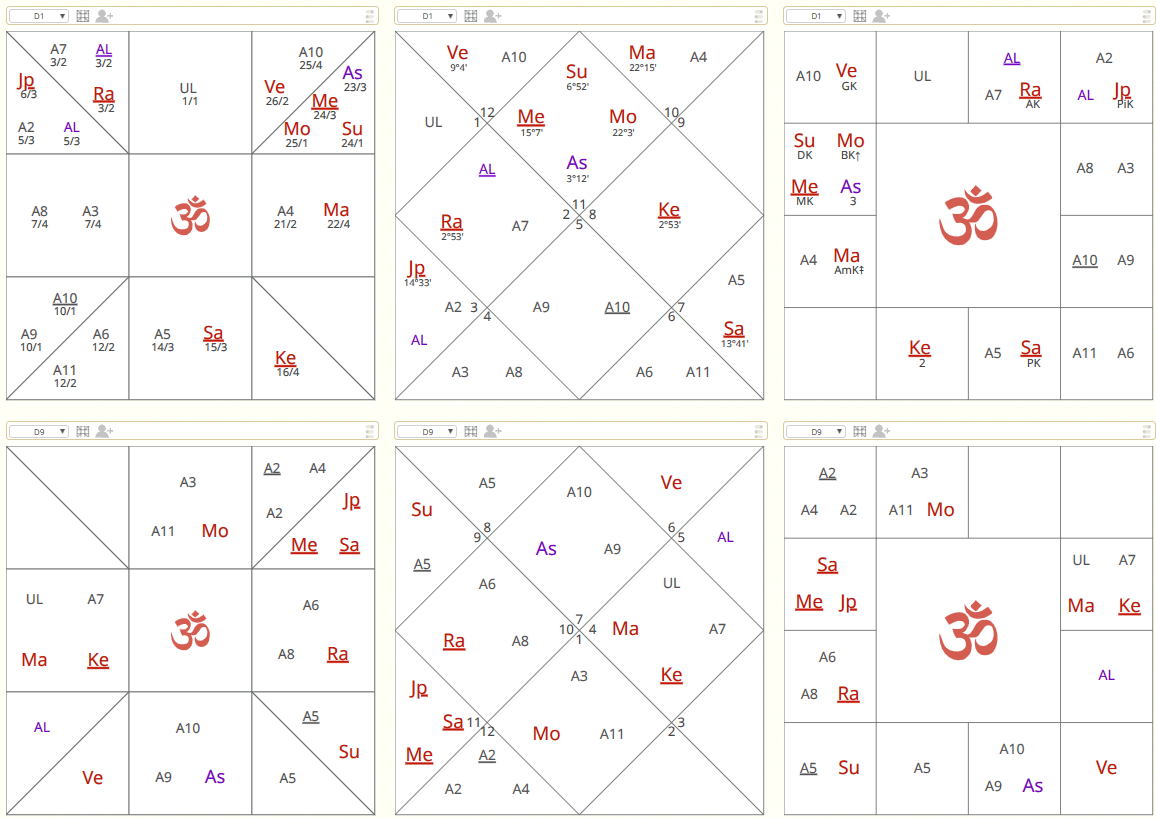
Example 1:
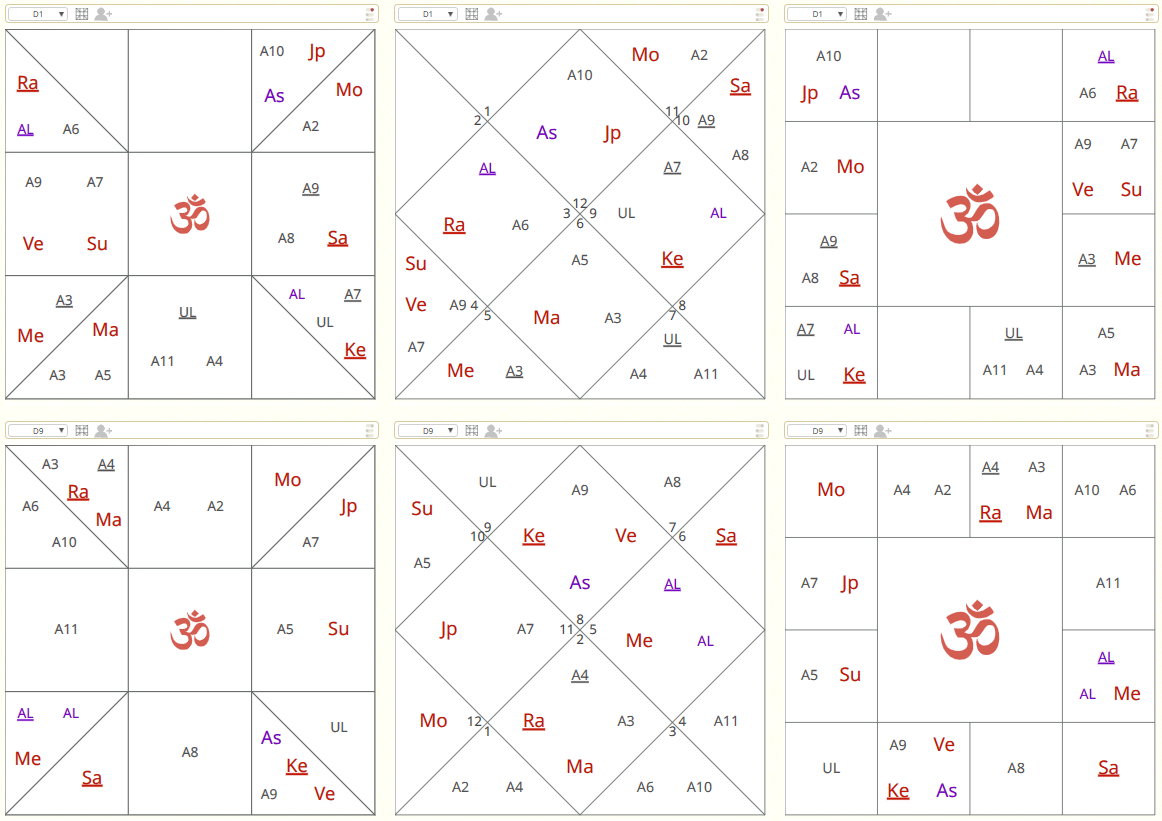
In this example, the Navāṁśa Lagna is Scorpio (Vṛścika). Looking at the second house from Scorpio, we arrive at the tenth house, where the exalted Ketu is placed on the Ārūḍha Lagna.
Thus, the focus of karma will be astrology and spirituality. This is especially reinforced because the lord of the Ārūḍha Lagna, Guru (Jupiter), is placed in the first house, giving a strong Hamsa Mahāpuruṣa Yoga.
Although the person spent a long time pursuing a career in the background, related to their engineering knowledge, at one point they gave it all up and devoted themselves fully to Jyotiṣa.
Ketu (Mokṣa Kāraka) is exalted in both the Rāśi chart and its own sign in the Navāṁśa, emphasizing spiritual focus and liberation
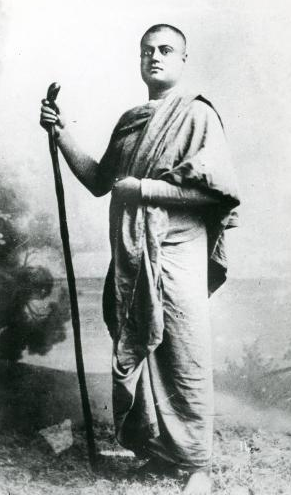
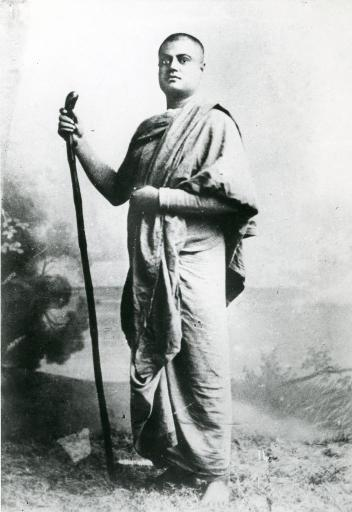
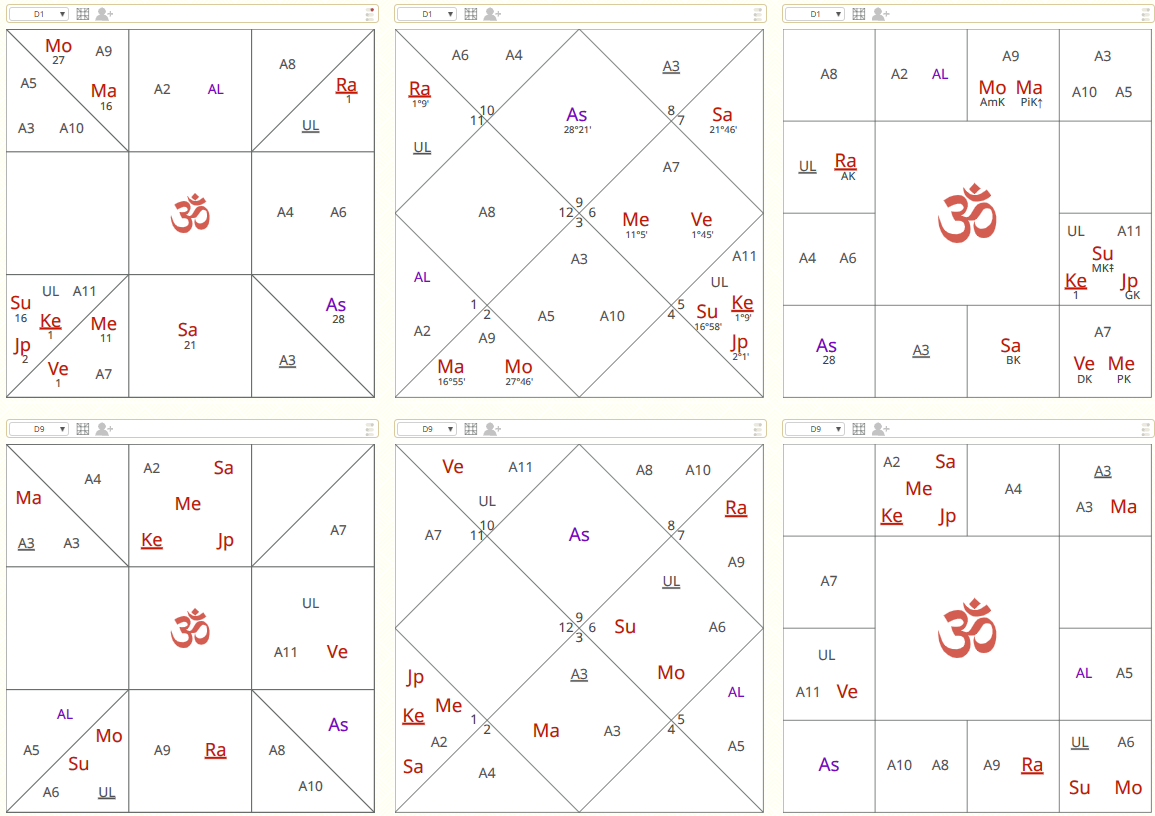
Example 2: Svāmi Rāmakṛṣṇa Paramahamsa
The tenth house contains Ketu in Digbala, which represents the upward direction, Ananta Devatā. Ketu is in high dignity and represents the Mokṣa Kāraka and the path of renunciation. It is in the seventh Bhava from Rāhu, Ātmakāraka showing ultimate goal of the soul.
Example 3: Śrīla Prabhupāda
Here we see that the Lagna is Vargottama, and it itself gives the capacity for great achievements in life. The second house from the Navāṁśa Lagna is Makara in both the Rāśi and the Navāṁśa. The second house relates to family. Śrīla Prabhupāda was a family man and chose a separate way of life (Sanyāsa) later in life.
The second house in the Rāśi chart is ruled by Saturn, which is exalted in the eleventh house from the Lagna and the seventh from the Ārūḍha Lagna. The position in the seventh house from the Ārūḍha Lagna plays a major role, because Saturn there has full Dig Bala (directional strength) and is able, if a person moves in its physical direction, to give complete blessings.
Saturn is also the Bhrātṛ Kāraka, which is observed as the Guru Devata in the chart. Śrīla Prabhupāda went to the West (the direction of Saturn) on the instruction of his Guru and there established the Kṛṣṇa Consciousness Movement, which has become a very strong spiritual institution of the present day.
3. Other Circumstances in Life
As in the previous cases we paid attention to the overall Karma, in the same way we can see our focus for any area of life. For example, for the focus related to children, we take the same rules as for Karma.
Thus, the divisional chart of seven (Saptāṁśa D-7) relates to children. The Karya Bhava in Saptāṁśa is the fifth. Now we should count from the fifth house to the tenth house and we obtain six. When we return the Saptāṁśa Lagna to the Rāśi chart, we should count six houses from that house, and we will obtain what the focus related to children is in this life.
Example 4: Care for Children
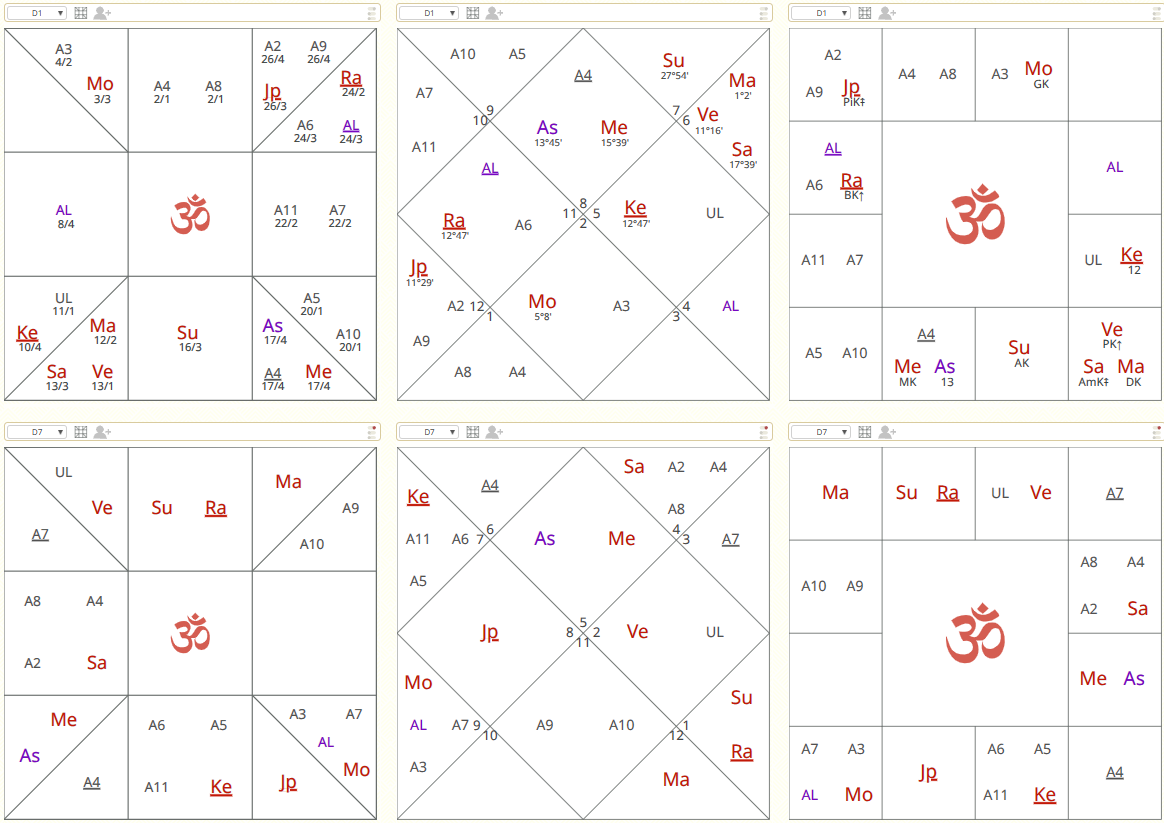
In this example, the Saptāṁśa Lagna is Siṁha, and when we return it to the Rāśi chart and count six houses, we arrive at the third house. Therefore, the third house should show the person’s focus regarding children. The third house is aspected by Ketu and Chandra, which indicates a very protective attitude of the person toward children, especially because Ketu is also the co-lord of the Lagna[2].
The lord of the third house is Saturn, which is located in the eleventh together with debilitated Venus, who is the Putrakāraka, and with Mars. The Putrakāraka, who rules the twelfth house (closed institutions, etc.) and who is under a curse, is placed in Pāpa Kartari Bandhana Yoga (the same number of malefics in the second and twelfth houses from itself). All of this indicates unfavorable conditions.
The person has many problems with children. He was often forced to give large amounts of money to pay fines caused by the children. He also had to face their going to prison on several occasions and similar situations. The lord of the second house is located in the fifth house and is aspected by Rāhu, Saturn, and Mars. This shows that a significant amount of money will go toward the children, and due to the aspects of malefics, the reasons will not be favorable.
In order to see what will be the main focus related to profession and career, we simply return the tenth house from the Dasāṁśa (D-10) to the Rāśi chart, because the tenth house is the Karya bhava for the Dasāṁśa, and that is the number one.
ॐ तत् सत्
om tat sat
[1] Swami Vivekananda – beginning of the book “KARMA YOGA”
[2] Here a story from the Purāṇas can be used in order to better explain the Chandra/Ketu combination. Ketu is Gaṇeśa, and Chandra is Devi. Gaṇeśa was entrusted by his mother (Devi) to protect her while she was bathing. He took this role very seriously and did not hesitate to enter into conflict with Śiva in order to fulfill his mother’s wish. On the other hand, Devi became very angry when she saw that Śiva had killed her son and was ready to completely destroy Creation because of it. Therefore, all the Devatās did everything they could to bring her son back to life.
ॐ कृष्ण गुरु
om kṛṣṇa guru