Jyotiṣa is here to help us understand how God influences our lives. It involves analyzing signs and planets, but there are many other parts to it. The mentioned analysis takes up the largest part. Jyotish uses the geocentric system of the Universe because the focus is on us, on Earth. So, we are at the center. We have other bodies moving around us to analyze them. First, we look at the Earth around us, then we observe the first orbit around us, which includes bodies that move, from planets to meteors. And above that is what we call stars. These are the three parts. The first part, in which we are called Bhū, then comes Bhuva, which is behind Bhū. And what is around all of this, the last point of analyzing what is in this Universe, is called Svarga. In Svarga, there are signs or Rāśis. We analyze Karma from Svarga. The ideology is that the manifested God dwells here. In Vedic understanding, God is called Deva. Deva comes from the word Diva, which means light. Anything that gives light is God. The Devas that are here give us knowledge related to Karma. God is above the manifested Universe.
The concept of Karma, which refers to the actions and consequences from our past lives, influences the movement of the bodies in Bhuva Loki. These bodies, known as planets, block the light of the Deva, which affects our perception of God. Depending on our Karma, these planets can either provide us with a wealth of knowledge or hinder our understanding entirely. They move in Bhuva Loki, which is the space between the stars (Devas), further demonstrating how Karma affects our spiritual journey.
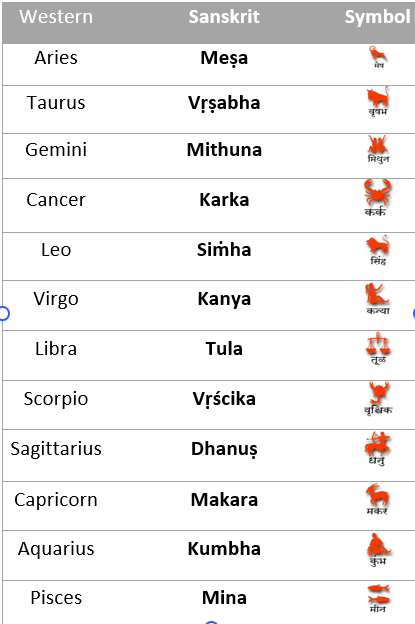
The placement of these planets in our individual astrological chart is determined by our Karma. This chart divides Svarga Loka into 12 parts, beginning with Aries and moving counterclockwise. The chart is drawn differently depending on whether it is observed from above or below, which affects the interpretation of the placement of the planets.
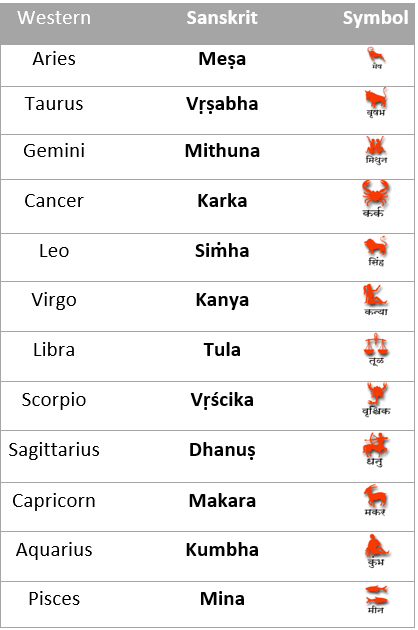
The Zodiac is a celestial belt consisting of 360 degrees, divided into 12 signs, each spanning 30 degrees. The position of the signs is determined by the stars, which are grouped into 27 constellations or Nakṣatras. Each Nakṣatra is ruled by a planet, as follows:
| # | Nakṣatra | Ruler |
|---|---|---|
| 1 | Aśvinī | Ketu |
| 2 | Bharaṇī | Śukra |
| 3 | Kṛttikā | Surya |
| 4 | Rohiṇī | Chandra |
| 5 | Mṛgaśirā | Mangal |
| 6 | Ārdrā | Rahu |
| 7 | Punarvasu | Guru |
| 8 | Puṣyā | Śani |
| 9 | Aśleṣā | Budha |
| 10 | Magha | Ketu |
| 11 | Pūrva Phalgunī | Śukra |
| 12 | Uttara Phalgunī | Surya |
| 13 | Hastā | Chandra |
| 14 | Chitrā | Mangal |
| 15 | Svāti | Rahu |
| 16 | Viśākhā | Guru |
| 17 | Anurādhā | Śani |
| 18 | Jyeṣṭhā | Budha |
| 19 | Mūla | Ketu |
| 20 | Aṣāḍhā | Śukra |
| 21 | Uttara Aṣāḍhā | Surya |
| 22 | Śravaṇā | Chandra |
| 23 | Dhaniṣṭha | Mangal |
| 24 | Śatabhiṣaj | Rahu |
| 25 | Pūrva Bhadrapada | Guru |
| 26 | Uttara Bhadrapada | Śani |
| 27 | Revatī | Budha |
The Chitra star, now known as Spica, is located at precisely 00 Libra or Scorpio. When the vernal equinox occurs, around April 21, astrologers observe the position of Chitra to determine the exact beginning of Aries, from which all other signs are formed.
In the Vedic system, there are five planets, each representing an element. Mars symbolizes fire, Venus represents water, Mercury is associated with earth, Saturn is connected to air, and Jupiter represents ether or vacuum. These five planets are used because they symbolize the four elements and one binding element.
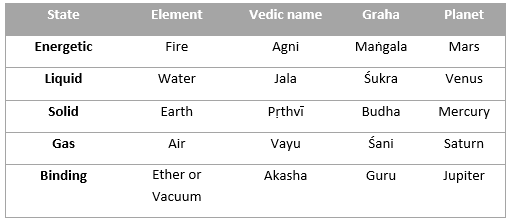
In addition to the planets, there are two luminous bodies that represent creation – the Sun (Surya) and the Moon (Chandra). However, there are also bodies that eclipse the light, known as the North and South nodes, which are mathematically defined points.
When the Moon gracefully orbits around the Earth, it reaches its lowest and highest points in relation to our planet, passing through the midpoint at two distinct positions. The southern node, known as Ketu, leads the Moon to its lowest point, while the northern node, known as Rahu, guides it to its highest point. The Moon’s alignment with the Sun during these moments causes a breathtaking natural phenomenon known as an eclipse, occurring twice a year in either a Solar or Lunar form. These nodes symbolize the cycle of birth and death, representing the physical creation’s destruction. The other five planets showcase what we are born with.
The Sun represents our soul, the Moon reflects our mind, and the five planets embody our physical body. Rahu exposes our bad karma carried over from past lives, while Ketu reveals the karma we have unintentionally created.
Graha, meaning eclipse, defines the planets’ ability to overshadow. As such, they stand between the stars (Deva) and Earth, causing stunning eclipses. Beyond Saturn, we find the Upa Graha, which do not possess the power to eclipse like the Grahas. Thus, in Vedic astrology, only the five Grahas are used. These planets control our way of thinking, while the Upa Grahas may influence other aspects of our lives unrelated to the mind.
ॐ गुरवे नमः om gurave namaḥ